- Home
- China
- World
- Asia-Pacific
- Americas
- Europe
- Middle-East and Africa
- Politics
- Business
- Opinions
- Tech & Sci
- Culture
- Sports
- Travel
- Nature
- Picture
- Video
- Live
- TV
- Specials
- Learn Chinese

 Europe;United Kingdom
Share







Copied
"I firmly oppose any act to smear China," said actor Wang Yibo, 22, in a statement as he ended his contract as a representative for sportswear giant Nike in China.
The singer, TV presenter and professional motorcycle racer, who came to fame as a member of the boy band Uniq in 2014, has become the latest Chinese celebrity to break his ties with a Western fashion brand, over claims of forced labor in the cotton industry of China's Xinjiang Uygur Autonomous Region.
By the end of Wednesday, three leading Chinese e-commerce sites had removed products from Sweden fashion chain H&M over similar claims.
Elsewhere, stock markets in Hong Kong and Shanghai are preparing for more homecoming listings from Chinese firms facing sanctions on U.S. exchanges, after the latest announcement from the regulator, the Securities and Exchange Commission.
U.S. market officials are also reportedly probing the growth of special purpose acquisition companies (SPACs) as figures reveal the market has surged in value to $170 billion so far this year, compared with $157 billion for the whole of 2020.
Meanwhile, Salvage experts say the Suez Canal could be blocked for days to come, as efforts continue to dislodge the grounded vessel blocking one of the world's busiest shipping lanes.
We also speak to one auto market expert about the new Chinese Zeekr electric vehicle brand, that plans to take on Elon Musk's Tesla.
And as the world powers to a greener motoring future, our graph shows just where and by how much greenhouse gases have fallen in the UK under lockdown.
Read on for more of the day's business news in full.
Louise Greenwood
Digital correspondent
P.S. Did someone forward this to you? Sign up here
Source: CFP.cn
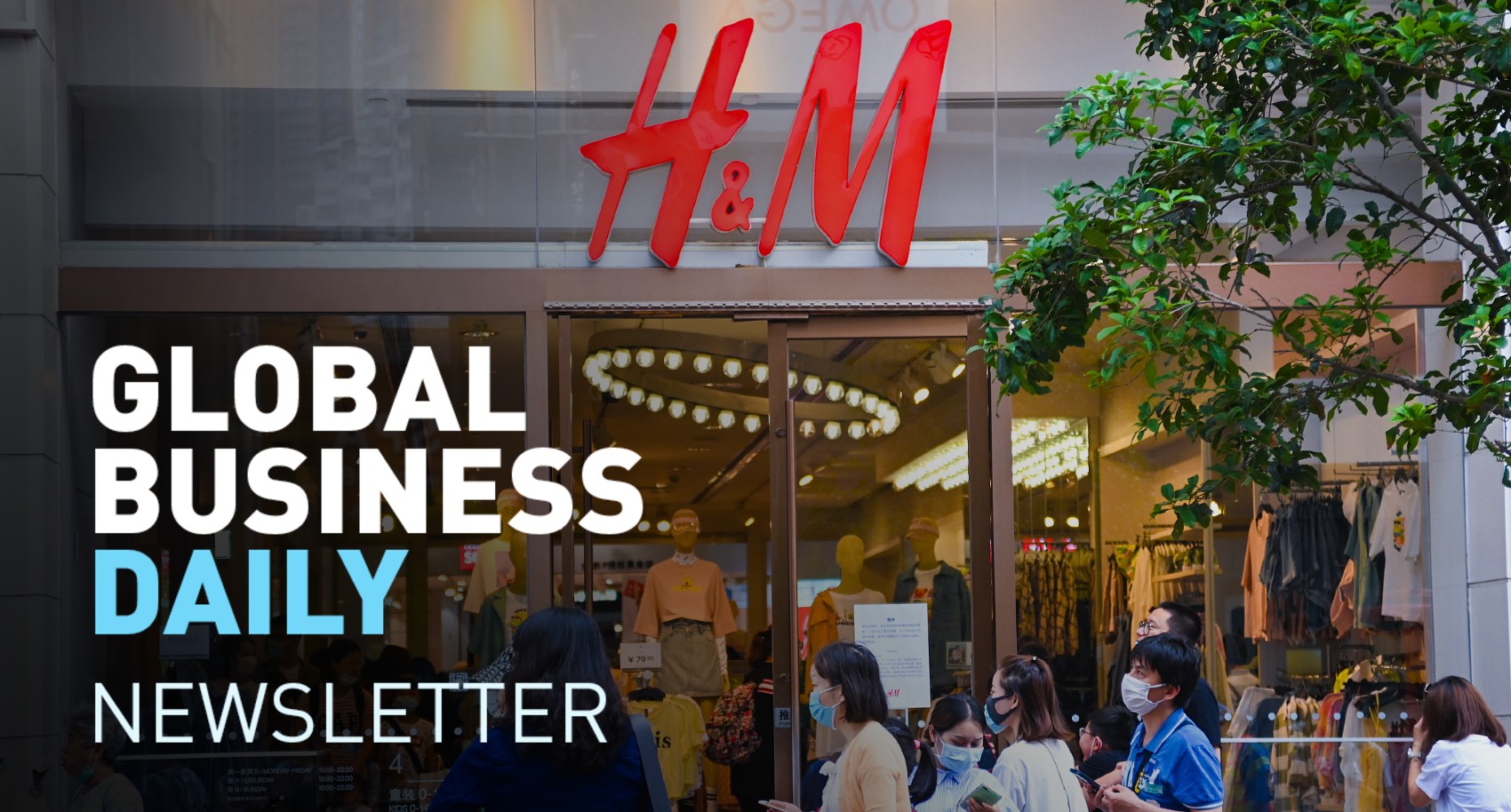
Western fashion retail giants H&M and Nike are facing a consumer backlash in China over claims that forced labor is being used in the production of cotton in the Xinjiang Uygur Autonomous Region. Some of China's leading celebrities have cut ties and endorsement deals with the firms, while e-commerce platforms have dropped H&M products from their range of goods, including Pinduoduo, JD.com and Tmall.
China has again condemned claims that forced labor is being used in Xinjiang Uygur Autonomous Region to produce cotton for global clothing manufacture. Earlier this week, the world's second biggest fashion retailer, Sweden's H&M, said it was "deeply concerned" by accusations of forced labor in Xinjiang, adding that it did not source products from the Chinese region.
A similar announcement from the sporting goods firm Nike has boosted shares in domestic Chinese sportswear makers Li Ning and Anta Sports, amid signs on social media of a possible boycott of the Oregon, U.S.-based firm. Elsewhere, the Chinese branch of Japanese garment and home goods retailer MUJI has confirmed that it does carry out manufacturing with Xinjiang cotton.
A Chinese Foreign Ministry spokesperson has dismissed claims that "forced labor" is used for cotton production in Xinjiang, saying the allegations are part of a smear campaign.
Shares in dual-listed Chinese companies have fallen sharply after U.S. regulators adopted new measures to remove foreign companies from domestic exchanges. The Securities and Exchange Commission (SEC) says it will take action against Chinese firms if it is deemed their accounting practices are incompatible with U.S. auditing standards. The policy change adds to existing plans by SEC officials to crack down on Chinese technology companies over competition concerns. The Holding Foreign Companies Accountable Act was signed into law by then-President Donald Trump in December.
While the value of NYSE listed Chinese companies, including the Alibaba Group and JD.Com fell on the Hong Kong markets, shares were up in the operator of the city's main stock exchange itself, the Hong Kong Exchanges and Clearing. The rise of 3.3 percent came amid hopes of more homecoming listings from Chinese tech firms. China's Foreign Ministry described the SEC decision as "clearly discriminatory," adding it will damage the reputation of U.S. capital markets.
Elsewhere, the U.S. securities regulator is reported to have opened an inquiry into so-called Special Purpose Acquisition Companies (SPACs) amid concerns about the growth in the popularity of so-called "blank-cheque" funds with start-up enterprises seeking backers. Officials have written to top Wall Street banks seeking information about how risks are being managed, clarification around fees, trading volumes and details of controls on deals.
Salvage experts are warning that the massive container ship stuck in the Suez Canal may not be shifted until Sunday. Some 156 vessels are estimated to be backed up in one of the world's busiest shipping lanes after the 200,000-ton Ever Given ran aground in sandstorms on Tuesday. An estimated $9.6 billion worth of goods are on hold, including consumer items, oil, gas and other commodities. The Suez Canal Authority has temporarily suspended traffic along the waterway as efforts to dislodge the ship continue.
Bitcoin has fallen for the fifth day in a row against the dollar, it's longest losing run since December, despite Tesla announcing this week that it will accept the currency as a form of payment for its vehicles in the U.S.. The virtual currency is down about 15 percent from its record high but remains up 700 percent overall in the past year.
READ MORE
Adventurer's lockdown survival tips
Suez canal blockage risks PPE delivery
How to share vaccines more fairly?
The UK's second-biggest mortgage lender, Nationwide Building Society, has become the latest corporate name to announce a "work-anywhere" policy for its staff in the post-pandemic era. The group says it will allow the majority of its 13,000 office-based staff to carry on working from home full time if they wish, after the results of an internal survey found most staff would like to work from home five days a week.
Online fashion retailer Boohoo is cutting links with some of its suppliers in an overhaul of its subcontracting business. The fashion giant was heavily criticized in a government-sponsored report last year into conditions at its supplier factories in Leicester, UK. Boohoo now says it has "ceased doing business with a number of manufacturers who were unable to demonstrate the high standard of transparency required."
A second UK fund manager has come out against investing in the food delivery giant Deliveroo ahead of its planned multi-billion-dollar float next month. Aberdeen Standard has described working conditions for riders at Deliveroo as a "red flag", adding that it is "not comfortable that the way in which its workforce is employed is sustainable." Yesterday, one of the UK's biggest pension fund providers Aviva Investors said it was boycotting the Deliveroo's forthcoming flotation, which has been valued at upwards of $7 billion.
After nearly two decades of trading on the Hong Kong exchange, the Chinese wireless carrier China Telecom Corporation is to seek a listing in Shanghai. China's oldest phone company said in March it had applied for the move to make its stock more easily available to Chinese mainland investors as the firm diversifies operations, selling up to 12 million shares, in a deal valued at $4 billion.
Cinema chain Cineworld has asked shareholders to approve a new loan facility after reporting a $3 billion loss for 2020. The London-based group, which made pre-tax profits of $155.2 million in 2019, has seen revenues plummet by 80 percent during lockdown. Cineworld says it remains hopeful of "strong pent-up demand" once theaters reopen in the U.S. in early April, with big-budget releases such as Marvel's Black Widow, and the James Bond movie No Time to Die planned.
UK holders of Mastercard could be in for a windfall as a court reconsiders a previous class-action law suit that the card overcharged more than 46 million customers over a 16-year period. A two-day court hearing will begin on Thursday to determine the $19 billion claim that Mastercard charged excessive "interchange" fees, which retailers pay credit card companies, between May 1992 and June 2008. Mastercard, which faces paying compensation of more than $400 to each customer affected, says it "fundamentally disagrees" with the case.
Ford is to stop making its Mondeo sedan as it shifts its European range towards electric and sport utility vehicles. As the U.S. car maker moves towards a fully electric future by 2030, the group says it will phase out the formerly bestselling Mondeo early next year, amid higher demand for SUV's and so-called crossover models like the Qashqai.
The Dutch consumer electronics giant Royal Philips is selling its domestic appliances business in a $4.4 billion deal with investment firm Hillhouse Capital. The terms include an exclusive brand license agreement for the new operators to use the Philips brand globally for the next 15 years on the group's leading products such as the LatteGo Espresso Machine, Elite steam generator and SpeedPro Max vacuum cleaner. Philips plans to refocus on health and wellbeing products.

A Geely Automobile production line in China. The company is planning to take on Tesla with its luxury Zeekr electric vehicle brand. /VCG
China's biggest car maker is launching a rival brand to take on Tesla in the electric vehicles market. Geely said it would develop and manufacture high-end electric vehicles (EVs) under the Zeekr brand and is expected to begin deliveries later this year.
CGTN Europe spoke to David Bailey, professor of Business Economics at the University of Birmingham, and asked him about the significance of the launch.
I think it really puts down a marker. What we've seen is Tesla really dominates the premium electric vehicle market in China. The Model 3 was the best-selling electric car in China last year. It's still selling well, as is the Model Y. Effectively, the Chinese have done really well in making budget electric cars, but they haven't really come up with offerings to compete with Tesla. Neo is starting to do that. And now Geely is trying to do it with this new brand Zeekr. It puts down a marker that it actually is not just going to be a low-end player, it's going to compete at the top end as well with Tesla.
How much of a game-changer is this?
What we've seen is Geely develop this really interesting strategy whereby they owned Volvo, they own Polestar, they've bought Lotus, the London Electric Vehicle Company that make electric cabs. They are now producing across lots of different brands, using the same underlying technology, the same platform that really helps them get costs down in the way that, say, Volkswagen does. And it's really leading the way in China in trying to do that. It means it can sell these different brands in different markets. So in Europe, it might well be Volvo or Polestar. In China, they're trying to develop these new market brands like Zeekr. So it's very much a global strategy.
Should Tesla be concerned or is competition a very good thing?
I think they should be concerned that the market is really hotting up. Tesla was a fantastic disruptor. Until they came along, we saw electric vehicles as ugly, slow and undesirable. Tesla made them sexy for the first time. So it changed our view of the market. It's dominated the electric vehicle market and it's grown very quickly. The competitors are now piling in, whether it's the like of Volkswagen, but also Geely coming along. And I think what's really important here is that Tesla itself sees China as the most important market going forward and that's where it thinks most of the growth will be. Now, the Chinese players recognize that as well. They want competitors for Tesla and the market is becoming a lot more crowded. So Tesla still has big advantages, but it's going to get tougher going forward.
And finally, government figures just out show the UK's greenhouse gas emissions fell by 8.9 percent in 2020 year-on-year – the steepest decline in nearly a century, as lockdown conditions led to an unprecedented drop in transport emissions. The one area bucking the trend was domestic emissions, which rose slightly.

