- Home
- China
- World
- Asia-Pacific
- Americas
- Europe
- Middle-East and Africa
- Politics
- Business
- Opinions
- Tech & Sci
- Culture
- Sports
- Travel
- Nature
- Picture
- Video
- Live
- TV
- Radio
- Specials
- Learn Chinese

 Europe;Brussels
Share







Copied
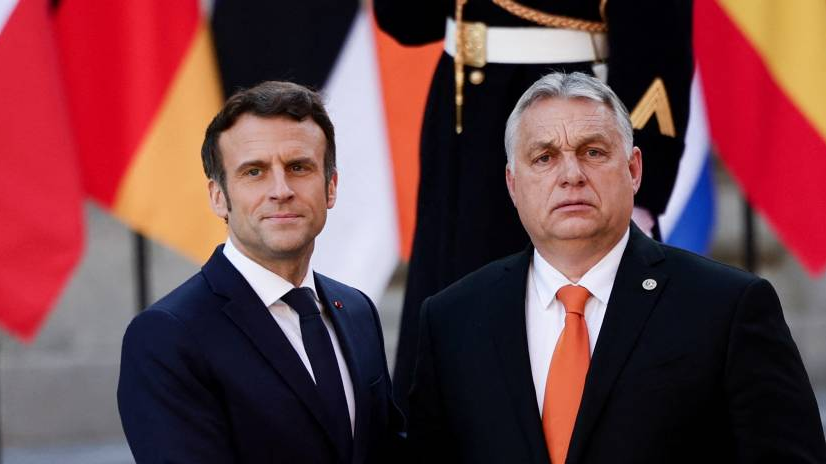
French President Emmanuel Macron welcomes Hungarian Prime Minister Viktor Orban as he arrives to attend an informal summit of EU leaders at the Chateau de Versailles. /Sarah Meyssonnier/Reuters
Thursday brings another meeting of European Union leaders. It will be their third gathering since the Ukraine conflict began a month ago – a month during which their unity and speed of action have surprised the world.
The conflict has transformed the position of Poland and Hungary in the bloc. Before it, both nations were involved in protracted legal battles with Brussels.
READ MORE:
'Stop this war!' A plea from a town of horror
On February 24, as the conflict began, an emergency meeting was held. Sanctions were rapidly announced on Russian banks, state-owned companies and the aviation industry.
"Tonight European leaders were fully aligned condemning the atrocious and unprovoked attacks," said European Commission President Ursula von der Leyen. "We have to meet the moment."
Welcomed back to Brussels
At the emergency meeting was Mateusz Morawiecki, the Polish prime minister whose government was found to have broken EU law over refugees in the past, and against which the EU had taken legal action on Poland's judicial independence.
It might have felt like hostile company, but Morawiecki didn't sound cowed. He said: "Enough of this cheap talking. There is enough naivety around us. Triviality. I believe we have to really act, to react in very decisive way."
And his country did. Every day, Poland welcomed people fleeing the Ukraine conflict. More than two million refugees have now arrived in the country.
The next assembly of EU leaders was at Versailles, outside Paris, on March 10. Hungary's Prime Minister Victor Orban was greeted warmly by French president Emmanuel Macron, despite Hungary being accused of breaking EU regulations over the rule of law and being criticized by other member states over its policies toward LGBTQ+ people.
Hungary has now taken in 300,000 refugees, and the country has turned away from sometime ally Russia and towards the EU. Macron was happy to pose for a handshake, and now it's even likely the EU will hold off using a new tool to keep back budget payments from countries accused of breaking the rules like Poland and Hungary.
New divisions?
But as one rift seemingly heals, another emerges, this time over energy. Germany is resisting sanctions on Russian oil and gas while leaders of Baltic countries, and Poland, are urging an end to its purchase.
EU leaders at Versailles ruled out immediate EU membership for Ukraine, though Eastern member states are keener than Western ones to find ways to speed up the application.
Every meeting of EU leaders has a roundtable, where the 27 leaders take a seat. It hasn't changed in number, but observers say a month of conflict has led to a change of pace and pecking order.
