- Home
- China
- World
- Asia-Pacific
- Americas
- Europe
- Middle-East and Africa
- Politics
- Business
- Opinions
- Tech & Sci
- Culture
- Sports
- Travel
- Nature
- Picture
- Video
- Live
- TV
- Specials
- Learn Chinese


Share







Copied
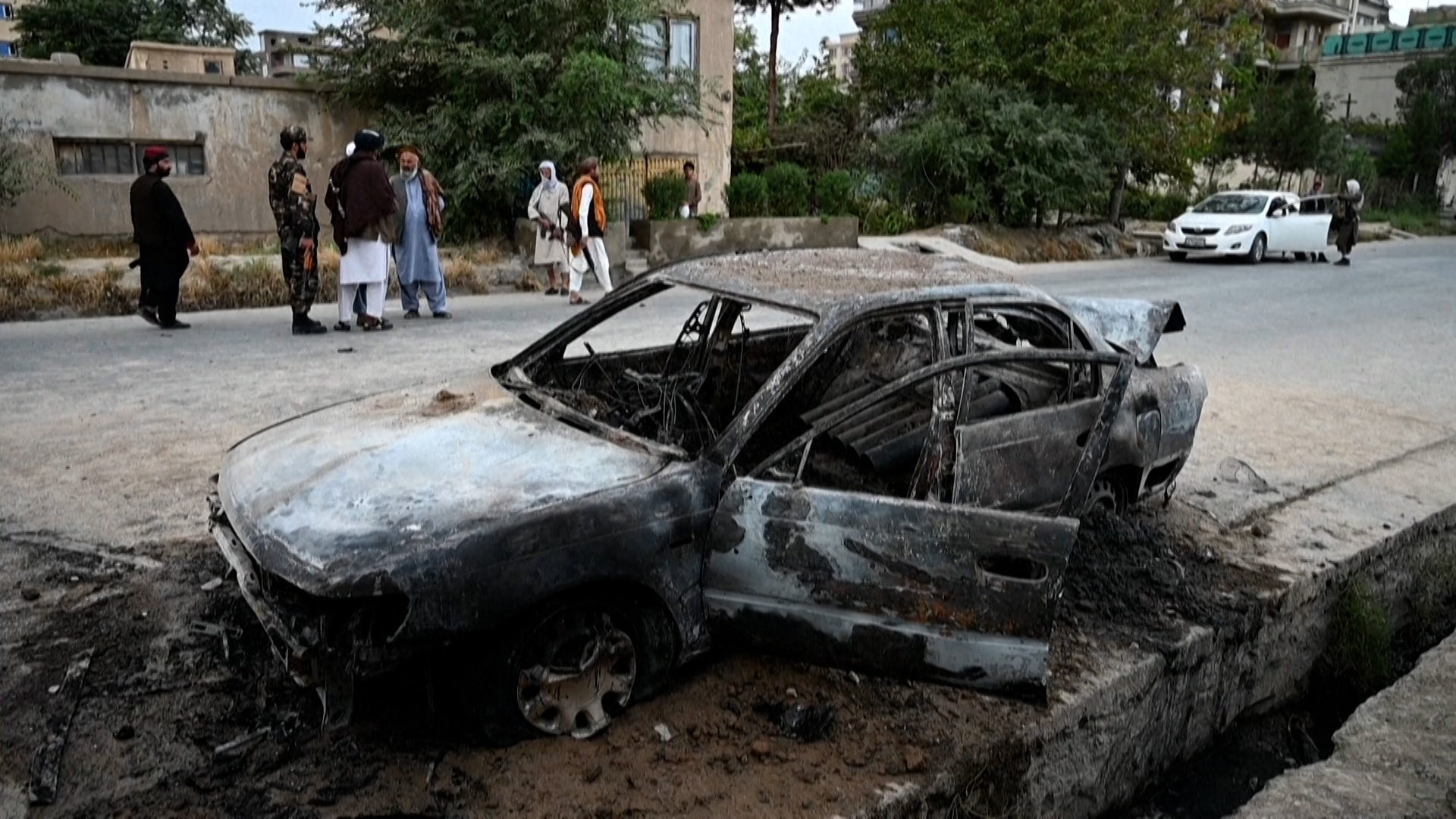
Under fire, the United States military is counting down the hours to leaving Afghanistan.
Since U.S. President Biden's pull-out announcement in April, all U.S. nationals and civilian Afghans who worked for them, will leave by the end of August.
There have been attacks in the past few days, with warnings that more are possible.
Just after daybreak on Monday several rockets were fired near Kabul airport.
A local man described sitting at his home, and hearing a loud noise,
" … We heard this terrible explosion, and I thought a rocket had hit somewhere. When I looked out of the gate, I saw rockets being fired at the airport from a car."
READ MORE:
It could have been retaliation for a U.S. drone strike on Sunday night, which the Pentagon said killed two members of the Islamic State Khorsan Province – known as ISIS-K group.
Up to ten members of the same family are thought to have died in the blast in a residential area of the capital city Kabul, six of them children and the youngest a two year old girl.
A relative said they were "an ordinary family," and went on to say, "we are not IS or Daesh and this was a family home -- where my brothers lived with their families."
The U.S. military is now investigating how civilians were killed in the strike, and in a briefing in the Pentagon in Washington D.C., Pentagon spokesman John Kirby said:
"...No military on the face of the earth works harder to avoid civilian casualties that the US military. And, nobody wants to see innocent life taken. We take it very very seriously and when we know we have caused innocent life to be lost in the conduct of our operations, we're transparent about it ..."
In central Kabul, as banks reopen, there have been long queues of men trying to withdraw money.
The Taliban have ordered banks to re-open, but have also ordered that a limit is placed on cash withdrawals. A maximum of $233 USD (20,000 afghani) is currently allowed.
The economy is fragile, especially in the face of so much political uncertainty . Shafa Khan, a taxi driver explained why many young people are leaving the country,
"...If the Taliban and politicians come together, the youth would be willing to stay… But, with what we see, young people won't stay in Kabul."
Food prices are rising, and there are fewer jobs.
There's bitterness towards the Afghan government who decided to make a run for it, and towards the Americans.
Mohammed Neman lives in Kabul, and complained the U.S despite being in Afghanistan for two decades did not improve the local infrastructure.
"… When Russia came here, it built buildings for the people and the government that still stands, but the Americans destroyed everything they built before leaving the country, just like the government they built here. Our president fled before the United States left. Also, unemployment is so high that on every street, you can see about 50 unemployed people."
There are calls for the Taliban to form a government and appoint ministers as quickly as possible. Education, press freedom and equality for women will be watched closely by Western countries.
On the weekend Abdul Baqi Haqqani , the Taliban's caretaker Higher Education minister said: "Afghans have fought against the biggest powers of the world with very little for the last 20 years. This sends a message to the world that Afghans won't abandon Islam, Afghan."
He went on to say: "We all have witnessed two changes in the last four decades (referring to the Soviet defeat and the American withdrawal), and from both changes we can conclude that Afghans won't accept anything but Islam, Afghans won't accept slavery, they won't accept the loss of their national values."
As the Americans continue to evacuate soldiers and some Afghan civilians, the UK government has completed its emergency evacuations, and James Cleverly, UK Foreign Office Minister interviewed on British TV said it will work with the Taliban, to an extent.
"They have made certain commitments about not taking out reprisals on individuals, about facilitating exit. Obviously, we are sceptical about those commitments. But we will continue working with them to an extent, based on their conduct to try and facilitate out further evacuation and repatriation effort."
There was some good news as a World Health Organization plane landed in Kabul, for the first time since the city fell to the Taliban. A plane with 12.5 tons of medical and other supplies.
