- Home
- China
- World
- Europe
- Politics
- Business
- Opinions
- Tech & Sci
- Culture
- Sports
- Travel
- Nature
- Picture
- Video
- Live
- TV
- Specials

 Europe;Europe
Share







Copied
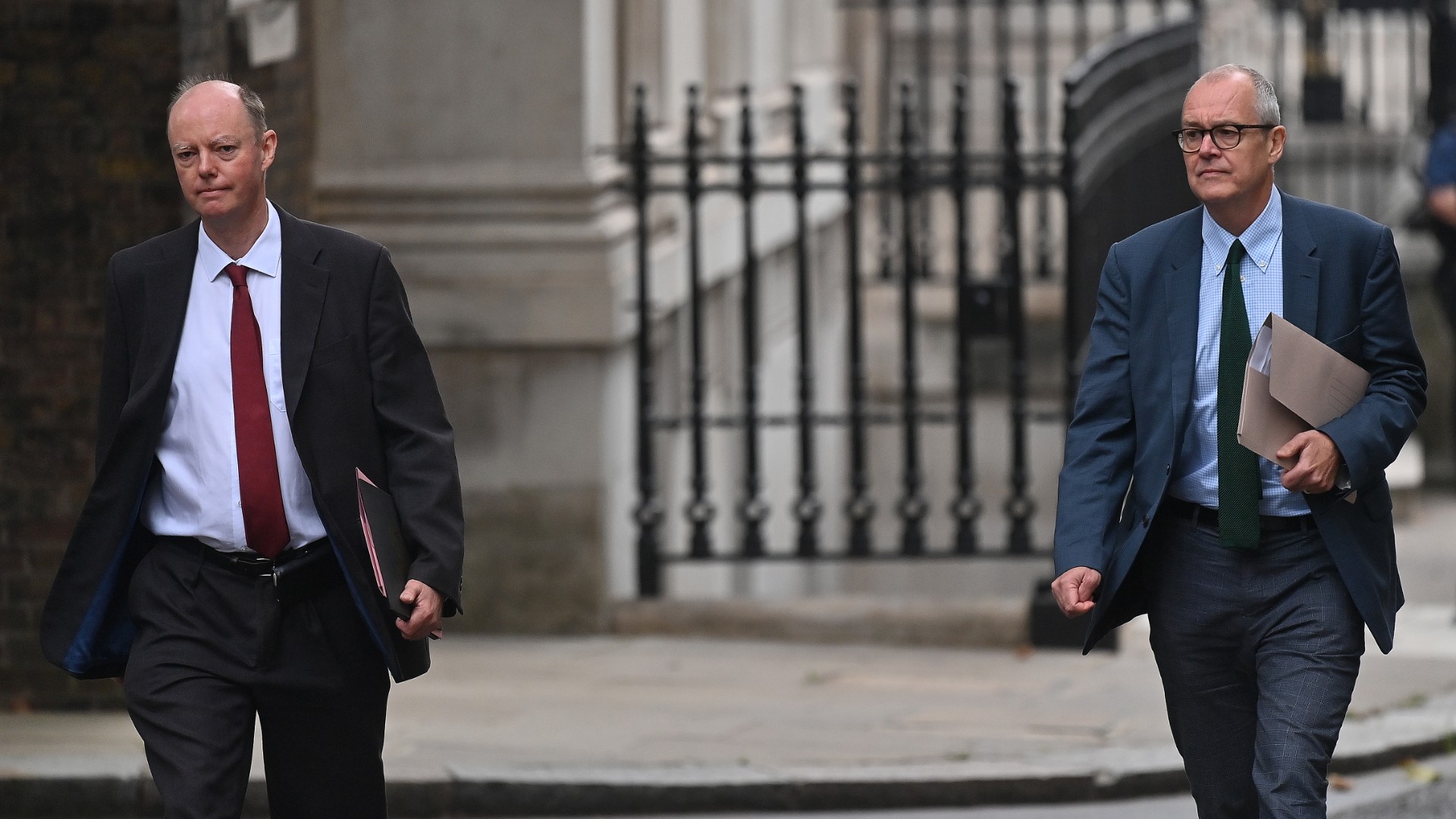
Chris Whitty (left, England's chief medical officer) and Patrick Vallance (the UK government's chief scientific adviser) said on Monday there could be 50,000 new cases of COVID-19 by mid-October if the virus is left to grow exponentially. /Ben Stansall/AFP
England's chief medical officer has said that COVID-19 is "a six-month problem we have to deal with collectively," adding that rising cases could reach 50,000 per day by mid-October if left to grow exponentially.
Chris Whitty told a news conference on Monday morning that, as autumn and winter approach and the virus spreads more easily, the UK "had literally turned a corner" in its attempts at controlling the virus.
"We should see this as a six-month problem we have to deal with collectively, it's not indefinite and in due course science will ride to our rescue, but in the next six months we have to take this very seriously," Whitty said, alongside Patrick Vallance, the UK government's chief scientific adviser.
"We have in a bad sense, literally turned a corner, although only relatively recently. The seasons are against us. Late autumn and winter benefit respiratory viruses and it is very likely they will benefit COVID-19 as they do for flu," he added.
Whitty added that the virus has lost none of its potency, as cases continue to double every seven days.
Five key messages from Whitty and Vallance
1 Cases growing exponentially
Vallance said the epidemic was doubling every seven days. That meant by next week there could be 10,000 new cases per day and by mid-October approximately 50,000 cases leading to more than 200 deaths per day by mid-November.
2 Winter is a big problem
Whitty, England's chief medical officer, said COVID-19 needed to be approached as a six-month problem until "science comes to the rescue." The upcoming winter months would also present a significant problem because late autumn and winter benefit respiratory viruses, likely to include coronavirus.
3 Learn to live with it
Vallance said vaccines were essential to learning to live with the virus. He believed a vaccine could be available to limited groups by the end of the year, but it would more likely be the first half of next year before one is available to the general population.
4 Striking a balance to protect health and the economy
Whitty warned that lockdowns, restrictions and curfews would have big social and mental health impacts. If the lockdown was too long and harsh there would be big increases in unemployment, poverty and deprivation.
5 Antibodies fade over time
Vallance said most people who were infected with COVID-19 got an antibody response that protected against the virus. However, over time these faded and people could become re-infected.
All ages affected
The United Kingdom already has the biggest official COVID-19 death toll in Europe – and the fifth largest in the world – while it is borrowing record amounts in an attempt to pump emergency money through the damaged economy.
Whitty also said new infections were affecting all ages.
"What we have seen in other countries, and now what we are clearly seeing here, is that infections are not staying just in the younger age groups, they are moving up the age bands and the mortality rates will be similar to what we saw previously," he said.
In case you missed it:
• Turkish YouTuber takes 'airbed' to the next level
• How can heat-seeking drones help save wildlife?
• Ground-breaking DNA study busts age-old myths about Vikings
Vallance, meanwhile, expected the number of more serious cases to increase as the virus reaches older, and more vulnerable, age groups.
"As it spreads across age groups we expect to see an increase in hospitalizations and unfortunately those increases in hospitalizations will lead to an increase in deaths," he said.
Vallance also said being infected with COVID-19 previously was "not an absolute protection" and the vast majority of the population was not immune. Estimates say eight percent of the UK population have developed antibodies, though in London the figure could be around 17 percent.
UK Prime Minister Boris Johnson is expected to address the country tomorrow with an update on the potential reintroduction of some lockdown measures.
Check out our new six-part podcast series Notes on a Pandemic as CGTN Europe finds out how business, science and people have risen to the challenge of COVID-19.