- Home
- China
- World
- Asia-Pacific
- Americas
- Europe
- Middle-East and Africa
- Politics
- Business
- Opinions
- Tech & Sci
- Culture
- Sports
- Travel
- Nature
- Picture
- Video
- Live
- TV
- Specials
- Learn Chinese

 Europe;Poland
Share







Copied
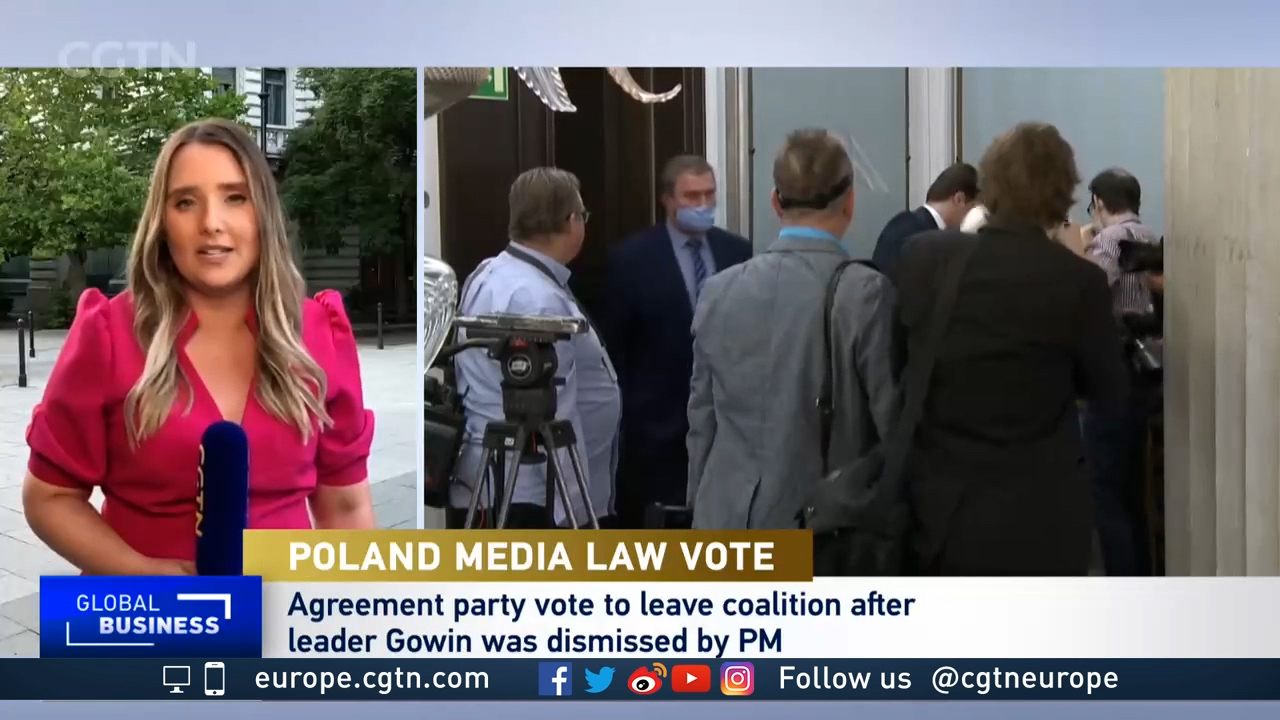
Poland's government is on the verge of falling apart, after the junior coalition member, the Agreement Party, said it would leave its Law and Justice Party partners during an ongoing row over a new media law.
Poland's Prime Minister Mateusz Morawiecki sacked the Agreement leader and Deputy Prime Minister Jaroslaw Gowin on Tuesday. And on Wednesday morning his party said it would take no further part in the ruling coalition.
The row started when the Law and Justice Party backed a draft law that would curtail foreign media ownership in the country and is widely seen as an attack on press freedoms.
Gowin and the Agreement Party oppose the law, and when he was in post as Deputy PM he said it "clearly violates the principle of media freedom."
Morawiecki and the Law and Justice Party said the new legislation was needed to make sure Poland's media were not "controlled" by foreign powers. If passed, the law would ban all non-European firms from owning Polish media outlets.
There was parliamentary drama on Wednesday as opposition lawmakers voted by 229 in favor and 227 against to suspend the session in order to postpone a vote on the law.
It was the fourth vote the government lost in the 460-seat lower house of parliament on Wednesday.
READ MORE
What you need to know about the IPCC's climate report
French cafes start checking COVID-19 health passes
Depression linked to social media twice as high in girls: UCL research
Former European Union chief Donald Tusk, who heads up the opposition Civic Platform party, wrote on Twitter that the government was "crumbling before our eyes." Adding: "It may go on for a while but it is no longer able to govern."
The reversals do not mean the government must fall, as a formal vote of no confidence by parliament would be required and it could continue as a minority government.
Commentators say a minority government would be difficult to sustain as it would have to rely on the far-right Confederation party, which is critical of the government.
Opponents have argued the proposed law is not designed to protect media, but to force U.S. broadcasting firm Discovery to sell Polish television station TVN.
There have been several public protests in recent weeks and months against the new law.
According to the bill's backers, the law would "clarify" existing regulations.
"The draft act aims to clarify the regulations enabling the National Broadcasting Council to effectively counteract the possibility of any entities from outside the European Union taking control of RTV [radio and television] broadcasters, including entities from countries posing a significant threat to state security," a statement read.
