
Share







Copied
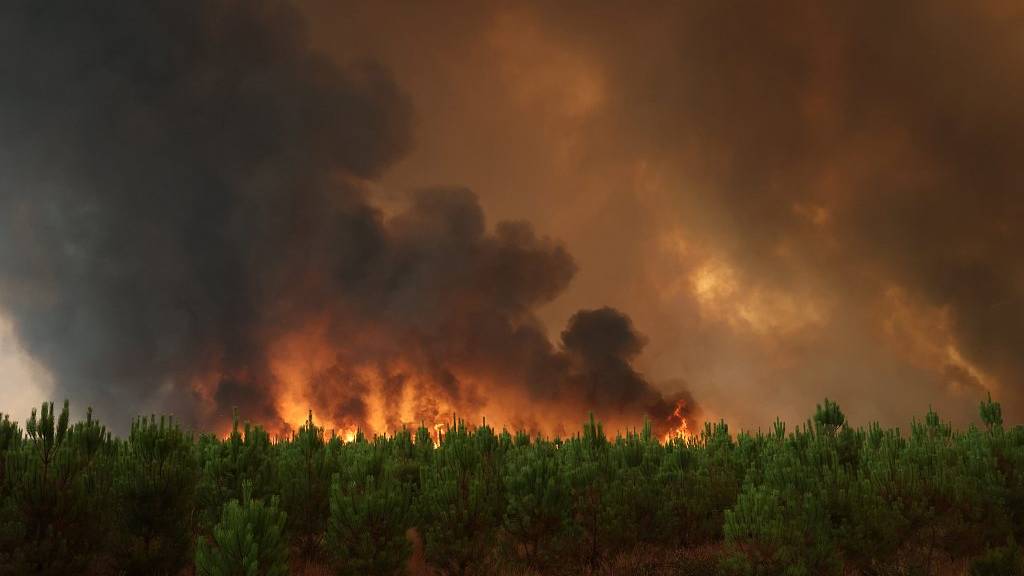
More than 10,000 people evacuated as wildfires continue in southwestern France in summer 2022 amid raging wildfires. /CFP
Many of France's famed pine trees that stretch along the country's southwestern Atlantic coastline were reduced to charred stumps by the massive fires that ravaged tourist hotspots of the Landes forest last summer.
In July and August 2022, more than 300 square kilometers of forest were burning – a record since mega-fires hit the region in 1949. And the damage to the landscape lives on in the local community.
"There has been a collective trauma," said Patrick Davet, mayor of La Teste-de-Buch, where thousands evacuated their homes as last year's fires raged around the town of about 26,000 inhabitants.
"There are people who have their bags ready to leave at any moment since last summer," he said.
READ MORE
Wagner chief Prigozhin returns to Russia
AI tools to predict extreme weather events
How European co-operatives inspired the world
This year, an unusually dry winter across southern Europe has left parched forests at risk of blazes from Portugal to France, raising concerns of a repeat of 2022, when 7,850 square kilometers were destroyed across Europe – more than double the annual average for the past 16 years.
Globally, rising temperatures and land-use change are projected to create a 50 percent rise in the number of catastrophic wildfires by 2100, according to the UN Environment Program.
Now governments around the world are left having to grapple with how best to protect their forests and local communities from the threat.
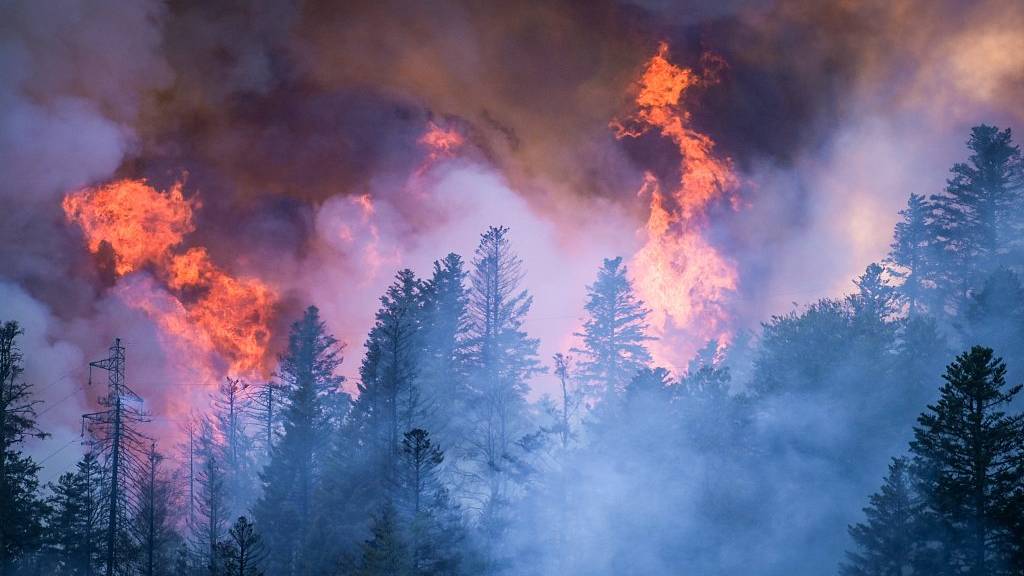
Rising temperatures are predicted to create a 50% rise in the number of catastrophic wildfires by 2100. /CFP
They also face tough decisions over how to replant burnt areas, including what tree species to use – and whether to introduce new ones to make forests more resilient to fire risk.
In the Landes forest, western Europe's largest man-made woodland, 87 percent of the trees are maritime pines, planted here since the rule of Napoleon III in the 18th century, to stabilize sand dunes and make the soil ready for farming.
Today, pine is a vital raw material for the construction and paper industries, while its resin is used in varnish and paint. In the Nouvelle Aquitaine region, the sector provides 50,000 jobs and an annual turnover exceeding $10.8 billion.
But pine is also highly flammable – and the single-species plantations common in the Landes allowe fire to spread easily.
"For four generations, our elders warned (the pine forest) would catch fire, and they were right," said local carpenter Clement Raufaste during a break from repairing fire damage at a restaurant by Cazaux lake.
"Pine resin is like gasoline – once the tree catches fire it lights up like a torch."
Tough summer
Last summer's fires destroyed not just trees but the local tourist industry in Nouvelle Aquitaine, one of France's leading holiday destinations.
In fire-affected zones, the hospitality industry saw an estimated 40 percent drop in earnings, and there are worries 2023 could bring another hit.
Eric Wendel, who owns dozens of mobile homes at a campsite by the lake, was lucky as the flames stopped 12 kilometers away on the other side, but convincing holidaymakers not to cancel bookings was a challenge throughout July and August.
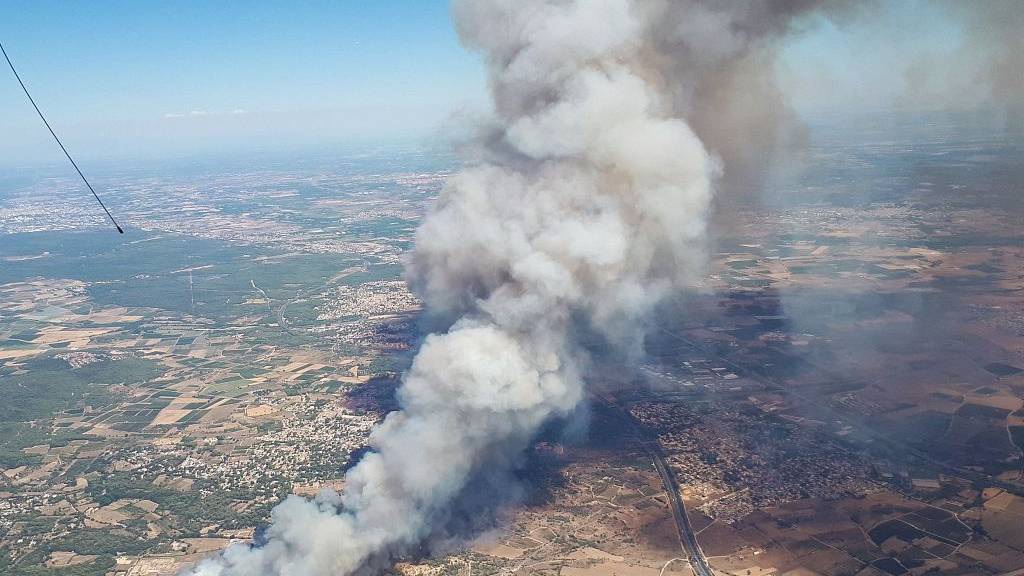
Last year's wildfire emissions in Europe amounted to 6.4 megatonnes of carbon, equivalent to the annual emissions of 5 million cars. /CFP
"We couldn't afford to lose customers (then) – that's when we make our living," he said.
Five campsites situated along Europe's tallest sand dune were reduced to ashes and are set to run at around half of their usual capacity this year.
"They're going to have a tough summer, and they will suffer for one or two (more) years," said mayor Davet.
With the peak fire season coinciding with peak tourist season – and 90 percent of fires caused by human activities such as discarded cigarettes, fireworks or unattended barbecues – educating people is key to preventing blazes, he added.
Measures set for this summer include a smoking ban in forested areas and extra police patrols.
Reforesting
Stopping forests from burning is key to protecting people and incomes – but also to fighting the climate crisis, as trees release the carbon they store when they burn.
Last year's wildfire emissions in Europe amounted to 6.4 megatonnes of carbon, roughly equivalent to the annual emissions of 5 million cars, according to the EU's Copernicus atmospheric monitoring service.
Yet while there are ways to ease the threat in the short term, debate about how to make forests safer in future continue.
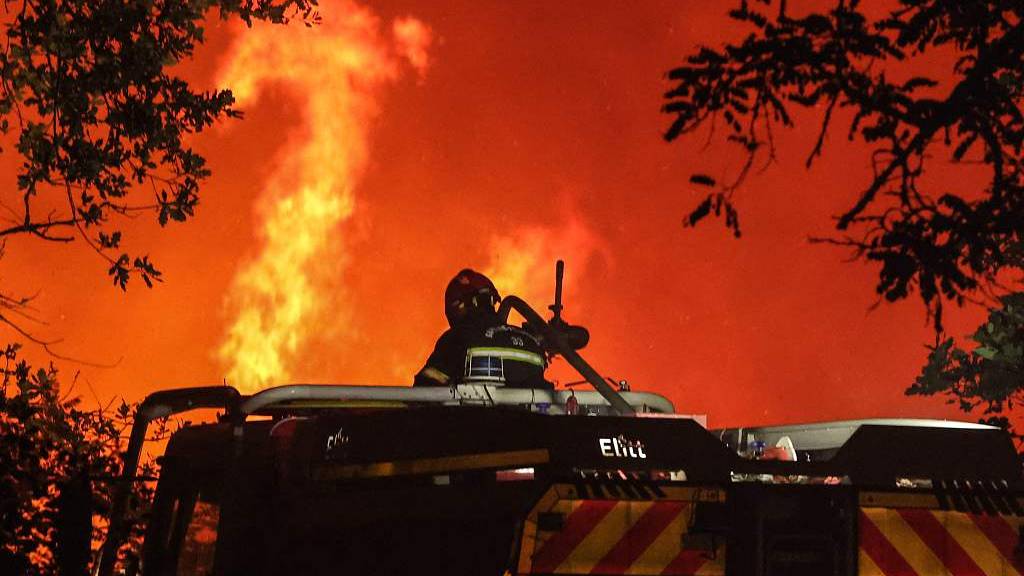
To combat the wildfires, French President Emmanuel Macron has announced a major reforestation plan that aims to plant a billion trees. /CFP
Last July, French President Emmanuel Macron announced a major reforestation plan that aims to plant a billion trees over the next decade, based on species and locations enabling forests to better face-off against climate-driven threats, including wildfires.
Since then, "everyone has had an opinion on how to replant," said forestry expert Christophe Orazio, who heads the European Planted Forest Institute near Bordeaux.
In the Landes, the arguments turn on whether to let the forest grow back naturally and ending pine supremacy. Conservationists want efforts to tackle problems they blame on industrial forestry, which favors single-species pine plantations, "meeting the needs of the timber market" at the expense of the environment, said Siim Kuresoo of FERN, a Dutch forest protection NGO.
Replanting monocultures of maritime pine means wildfires will continue to happen, he said. "It's not a question of if, but when and how severe," he added.
A two-hour drive south to Anglet, where 1.65m square meters burned in 2020, officials are taking an interesting approach to reforesting. Antoine de Boutray, director of France's National Forestry Office (ONF) in the Pyrenees-Atlantic region, worked on the replanting using cork oak and maritime pine, completed in March.
Regenerating the forest with a mix of species makes it more fire-resilient, as different types of "fuel" slow the spread of the flames and varied moisture levels reduce flammability, he explained.
"Biodiversity is our main ally in adapting forests to climate change - and the forestry industry will come to the same conclusion," de Boutray said.
Local forestry business Planfor, which specializes in pine, helped the ONF replant some of the burned-out forests. The head of Planfor's tree nursery, Jean-Marc Bonedeau, said that pushing the sector towards greater biodiversity will be a win-win for the local economy and the environment.
He added that he sees a willingness to change among the company's clients, "but you have to call a spade a spade - if there are no financial incentives, you won't achieve biodiversity."
But for now, La-Teste-de-Buch mayor Davet Davet is focused on the short term, recalling the lack of rain over winter and the hot summer days ahead, saying locals were scared, but stoic.
"Fear is only helpful when it protects us – so we remain vigilant," he concluded.

Subscribe to Storyboard: A weekly newsletter bringing you the best of CGTN every Friday
Search Trends
SITEMAP
Copyright © 2023 CGTN. 京ICP备16065310号

Disinformation report hotline: 010-85061466
SITEMAP
Copyright © 2023 CGTN. 京ICP备16065310号
Disinformation report hotline: 010-85061466