- Home
- China
- World
- Asia-Pacific
- Americas
- Europe
- Middle-East and Africa
- Politics
- Business
- Opinions
- Tech & Sci
- Culture
- Sports
- Travel
- Nature
- Picture
- Video
- Live
- TV
- Documentary
- Radio
- Specials
- Learn Chinese

 Europe;Ukraine
Share







Copied
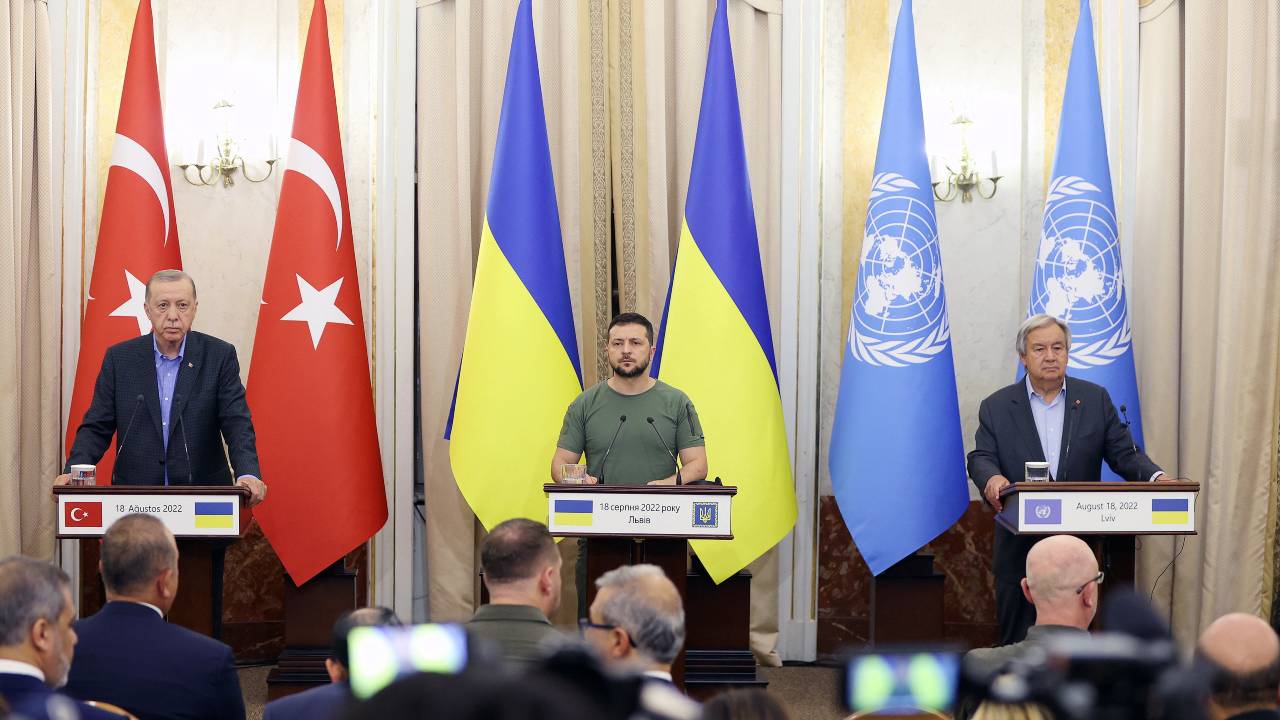
Turkey's Recep Tayyip Erdogan, Ukraine's Volodymyr Zelenskyy and UN chief Antonio Guterres in Lviv. /Turkish Presidential Press Office/Reuters
TOP HEADLINES
• Russia's foreign ministry has rejected a proposal by UN chief Antonio Guterres to demilitarize the area around the Russian-controlled Zaporizhzhia nuclear power plant in Ukraine, saying it would make the facility "more vulnerable".
• Ukraine's president Volodymyr Zelenskyy said after talks with the UN head in Lviv that the organization must ensure Zaporizhzhia's security, as Moscow and Kyiv continue to blame each other for shelling at the site which officials have warned could lead to a Chernobyl-style nuclear disaster. "This deliberate terror on the part of the aggressor can have global catastrophic consequences for the whole world," the president wrote on Telegram.
• Guterres also used the occasion to urge Russia and Ukraine to show a "spirit of compromise" and ensure the continued success of a UN-brokered deal that has allowed Kyiv to resume grain exports from its Black Sea ports.
• Turkish President Tayyip Erdogan, who was meeting with Zelenskyy and Guterres in Ukraine, said they discussed possible ways of ending the conflict, adding that he would raise the issue of exchanging prisoners of war with Russian President Vladimir Putin. "We attach great importance to this issue...of what happened to the exchange of these captives," said the leader.
• Three civilians were killed and more than a dozen wounded in a pre-dawn rocket attack on Ukraine's second biggest city, Kharkiv. The attack follows Russian shelling in the same city on Wednesday which killed a further 12 people.
• Russia's Black Sea fleet based in annexed Crimea has installed a new commander, state-run news agency RIA reported, after Russian military bases on the peninsula were rocked by explosions in the last two weeks. READ MORE BELOW
• Russia's foreign ministry said Moscow would only use its nuclear arsenal in "emergency circumstances" and that it has no interest in a direct confrontation with the Western military alliance NATO and its de facto leader, the U.S..
• Senior Ukrainian presidential adviser Oleksiy Arestovych urged Ukrainians to stop "canceling" Russians, called for them to instead persuade Russians to "switch to our side". The presidential adviser wrote a long Telegram post on Wednesday, hitting out at his countrymen for letting their emotions take over and "turning on the cancelation to the fullest."
• Estonia has fought off "the most extensive cyber attacks since 2007", it said, shortly after removing Soviet monuments in a region with an ethnic Russian majority. Hacker group Killnet claimed responsibility, stating on its Telegram account that it had blocked access to more than 200 state and private Estonian institutions, including an online citizen identification system.
• Denmark expects to invest 40 billion Danish crowns ($5.47 billion) in new warships as the NATO member seeks to bolster its maritime security amid the Ukraine conflict, its defense ministry said.
• Four more ships carrying agricultural produce have left Ukraine's Black Sea ports, bringing the number of vessels to leave Ukraine under a UN-brokered export deal to 25.
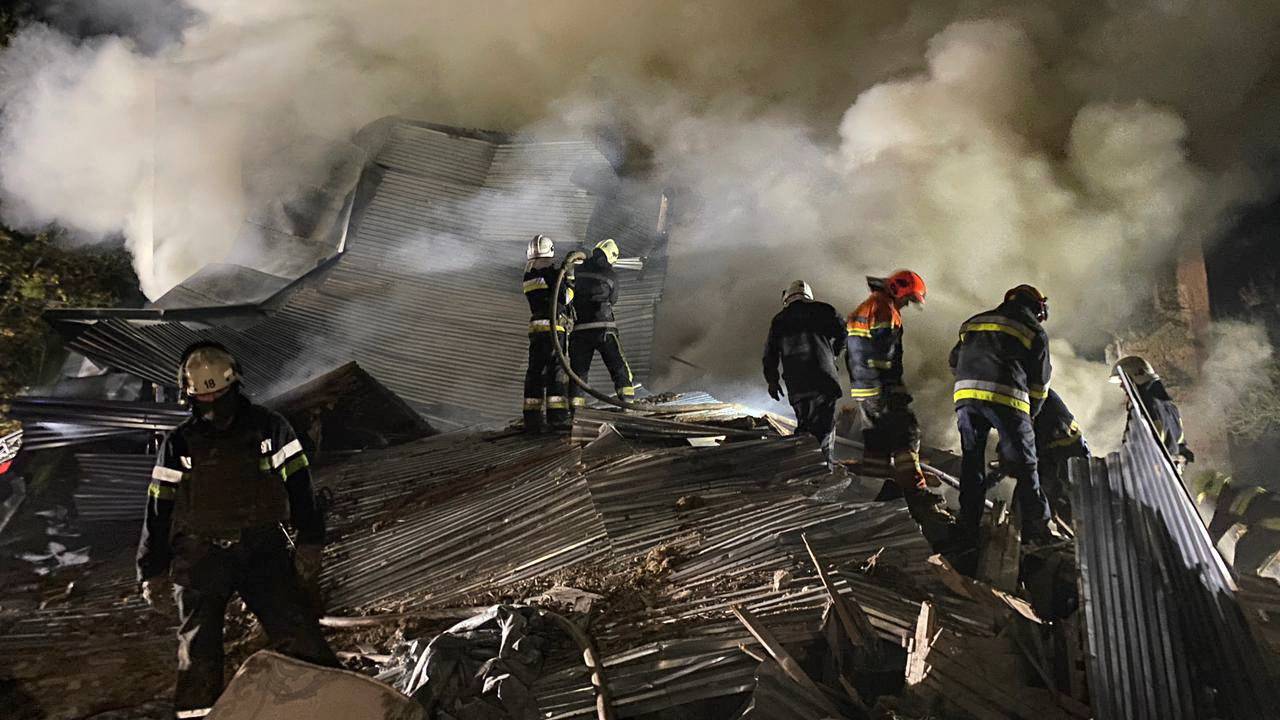
Rescuers work at the site of a residential building destroyed by a Russian missile strike in Kharkiv. /Vitalii Hnidyi/Reuters
IN DETAIL
Black Sea fleet commander replaced
A series of blasts at military bases and ammunition depots in the past week in Crimea has suggested a shift in the conflict, with Ukraine apparently capable of striking deeper into Russian-occupied territory – with Moscow shaking up its command on the annexed Black Sea peninsula.
The Kremlin has blamed saboteurs for the attacks, while Ukraine has not officially taken responsibility but has hinted that it had a hand to play in the strikes.
Ukrainian military intelligence said that after the recent blasts in Crimea, Russian forces had quickly moved some of their planes and helicopters deeper into the peninsula and to airfields in Russia.
Crimea, which Russia seized from Ukraine in 2014 and has extensively fortified since then, offers the main supply route for Russian forces occupying southern Ukraine.
READ MORE
CGTN special: Cost-of-living crisis across Europe
Meet the 'sappers' dealing with Ukraine's unexploded bombs
Which food has the worst environmental impact?
On Wednesday, Russia's RIA news agency cited sources as saying the commander of its Black Sea fleet, Igor Osipov, had been replaced with a new chief, Viktor Sokolov.
If confirmed, the change in personnel would mark one of the most prominent sackings of a military official in a conflict where Russia has suffered heavy losses of men and equipment.
The Black Sea Fleet, which has a revered history, has suffered several setbacks since President Vladimir Putin launched Russia's military campaign in Ukraine.
In April, Ukraine struck Russia's flagship the Moskva, a huge cruiser, with Neptune missiles. It became the biggest warship to be sunk in combat for 40 years.
One source said it was "normal" that the appointment of a new commander was not publicly announced considering it was wartime.
The previous Black Sea fleet chief, Osipov, 49, had been in charge since May 2019, according to his official biography on the defense ministry website.
His replacement, Sokolov, 60, had extensive experience of commanding minesweeping vessels and units in the 1980s and 1990s, then rose through a series of posts in the Pacific and Northern Fleets, serving as deputy commander in the latter. Since 2020 he has headed a prestigious military academy.

Search Trends
Copyright © 2020 CGTN. 京ICP备16065310号

Disinformation report hotline: 010-85061466
Copyright © 2020 CGTN. 京ICP备16065310号
Disinformation report hotline: 010-85061466
Copyright © 2020 CGTN. 京ICP备16065310号
Disinformation report hotline: 010-85061466