- Home
- China
- World
- Asia-Pacific
- Americas
- Europe
- Middle-East and Africa
- Politics
- Business
- Opinions
- Tech & Sci
- Culture
- Sports
- Travel
- Nature
- Picture
- Video
- Live
- TV
- Documentary
- Radio
- Specials
- Learn Chinese


Share







Copied
At 10:30 pm on a Friday, Arthur Brand received the delivery he was nervously expecting.
His bell rang, and when Brand opened the door, no one was there. Instead, a cardboard box was waiting for him at the door, in the dark.
In the box, Brand noted, was one of the most sacred artifacts ever stolen from the Catholic Church: the "Precious Blood of Christ" relic.
"(My) heart was beating in (my) chest," the Dutch art detective told AFP in an interview about the recovery of the stolen treasure.
READ MORE
Meet the Ukrainians rejecting their Russian language
Robo-arm could help millions
#MyFirstJob: How industry leaders started out
Brand is dubbed the "Indiana Jones of the Art World" for his remarkable recoveries of stolen art, including the "Hitler's Horses" bronze statues, a Picasso painting, and a ring that once belonged to Oscar Wilde.
At 52, he is one of the most famous art detectives in the world, trusted by both thieves and police for his unprecedented access to the illicit trade in stolen art.
But getting his hands on the 'Precious Blood of Christ relic was an exceptional experience for him.
"As a Catholic myself, this is about as close to Jesus and the legend of the Holy Grail you can get."
"It was a religious experience," he said.
'Massive shock'
When he opened the box, Bland discovered that the relic was perfectly intact.
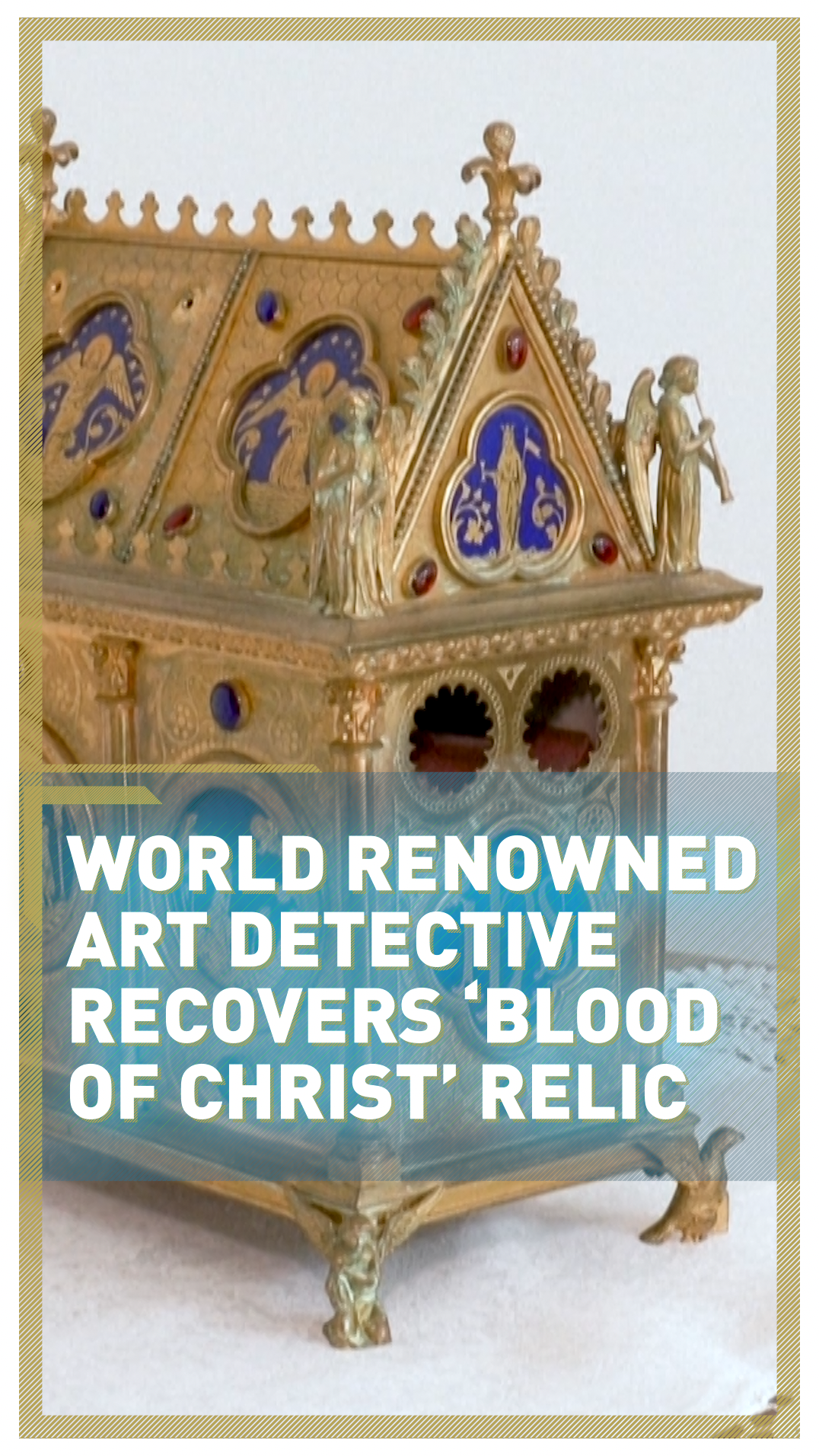
The ornate container, about 30 centimeters (11 inches) high, has two metal bulbs inside and is said to hold drops of Jesus's blood collected in the Holy Grail during his crucifixion.
It is held in a heavily gilded copper box with encrusted precious stones and depictions of Christ on the cross and other saints.
The holy relic is believed to date back to the death of Christ and has been a source of worship for Catholic pilgrims for more than 1,000 years.
It was held by the Fecamp Abbey in France's Normandy region until the night of June 1-2, when it was stolen, just two weeks before the annual 'Mass of the Precious Blood' celebration.
"The thief most likely got inside by being locked in after-hours and made off with the artifact," Brand said.
"It was a massive shock that this famous piece, this legendary piece, was stolen."
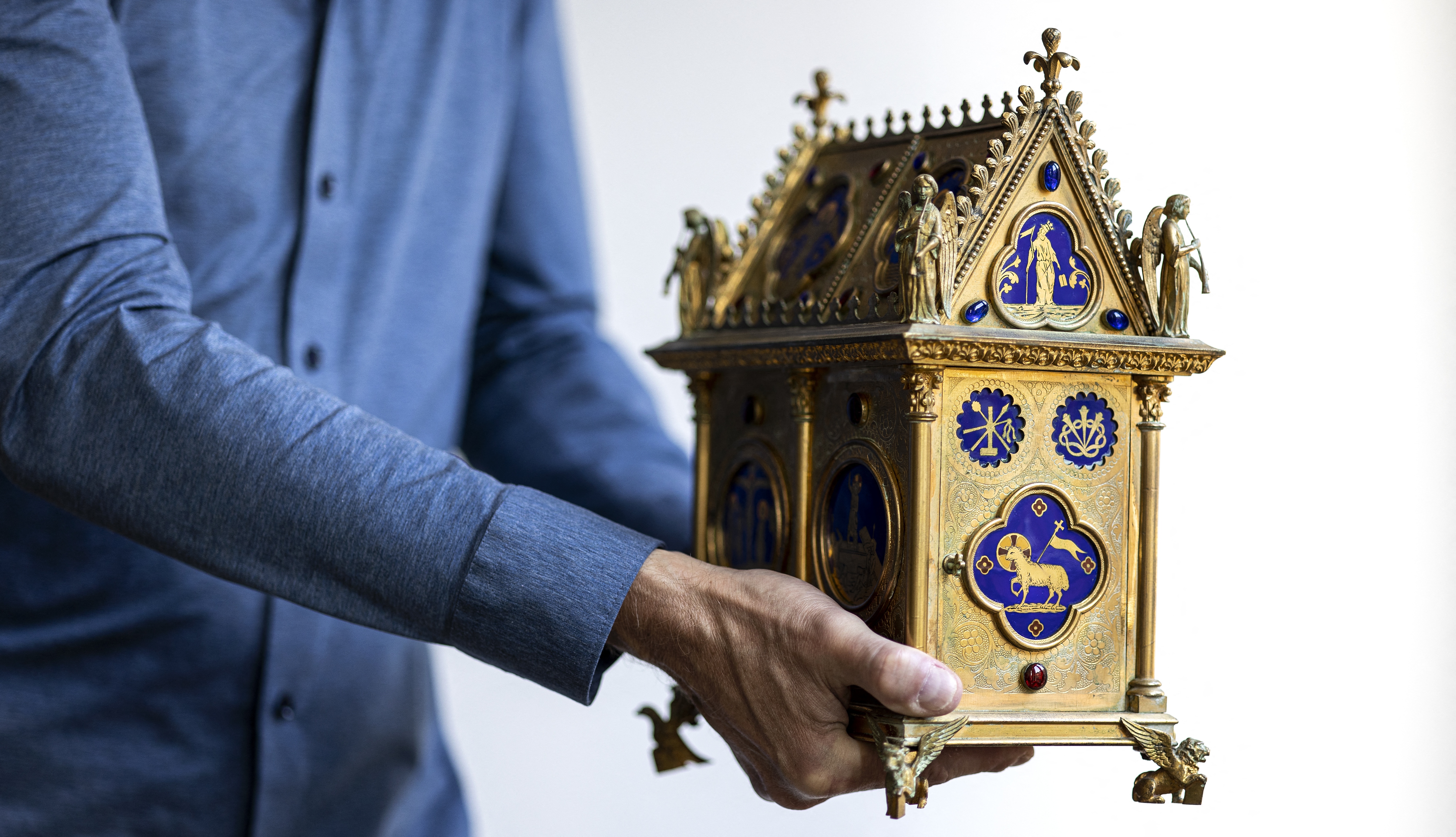
Dutch Art detective Arthur Brand poses with the relic of the 'Precious Blood of Christ.' /AFP/ANP/Ramon Van Flymen
Brand carefully showed AFP the ornate and heavy copper box with a miniature roof and four angels on its corners called a reliquary.
AFP could not independently verify the authenticity of the objects, and police or experts have not yet examined them. Neither could the abbey could immediately be reached for comment.
But Brand is sure about their authenticity.
"I have no doubt in my mind that it is the real thing. Religious objects are almost impossible to forge."
The sacred relic will be handed to Dutch law enforcement once they receive a request for mutual assistance from France, Dutch police said.
Once Dutch police receive the object, they will investigate the object's authenticity and try to identify the thief.
"After the investigation, our conclusions and the relic will be returned to the French police," Dutch national police spokesman Dennis Janus told AFP.
'A curse'
Brand said his involvement in the case started a few days after the theft, when he received a protected email from an anonymous writer claiming to have the stolen loot in their possession.
"This person was approaching me on behalf of another, at whose home the stolen relics were being stored," said Brand.
But "to have the ultimate relic, the blood of Jesus in your home, stolen, that's a curse," he said. "When they realized what it was, that you, in fact cannot sell it, they knew they had to get rid of it."
Brand showed AFP an email written in Dutch in which the person asked him to take back the stolen property, as it was too risky to return it to the abbey itself. Brand was told that the stolen artifact would be delivered to his home, but no date or time was given.
"I was virtually a prisoner in my own home for a week. I could not leave," he said, laughing.
Finally, the objects turned up, delivered by an anonymous sender.
Asked why the thieves would return the stolen art to Brand, he said, "it would be too dangerous to involve the police."
"These people know my reputation and that the most important thing is to return this to the church. Hopefully, it will stand for another thousand years," Brand said.
