- Home
- China
- World
- Asia-Pacific
- Americas
- Europe
- Middle-East and Africa
- Politics
- Business
- Opinions
- Tech & Sci
- Culture
- Sports
- Travel
- Nature
- Picture
- Video
- Live
- TV
- Radio
- Specials
- Learn Chinese

 Europe;Hungary
Share







Copied

Prime Minister Viktor Orban during the final Fidesz electoral rally ahead of Sunday's election, in Szekesfehervar, Hungary, on Friday. /Petr David Josek/AP
After his third consecutive landslide victory in 2018, Hungary's Viktor Orban said his strong new mandate allowed him to plan for 12 years ahead, aiming for an unbroken two-decade spell in power in the former communist Central European country.
On Sunday, Orban's long-term confidence will be put to a stern test in a national election where polls suggest six opposition parties united against him for the first time are within striking distance of unseating his nationalist Fidesz party.
Hungary holds general elections every four years, and Fidesz – first triumphant in 1998, before spending eight years in opposition – swept to victory in 2018 on a fierce anti-immigration campaign that earned Orban praise from Europe's far right and the then U.S. President Donald Trump but set him on a collision course with Brussels.
READ MORE
Human traffickers target Ukraine's refugees
E-sports makes Wolves a global brand
Now, the 58-year-old leader, who has transformed Hungary into a self-styled "illiberal democracy" with a firm grip over media and loyalists in charge of top institutions, acknowledges this election will not be a walkover.
"The stakes of this election are, even for an old warhorse such as myself, much higher than I could have ever imagined," Orban told pro-government channel HirTV on Monday.
Opinion polls give Fidesz a narrow lead, but with about one-fifth of Hungary's 8 million voters still saying they are undecided, the April 3 vote could yet go either way.
The vote will decide whether Brussels will continue to face concerted resistance from Hungary and Poland over media freedoms, rule of law and minority rights or Warsaw will be left isolated in its standoff with European institutions.
Defense of conservative Christian family values against what he calls the "gender madness" now sweeping Western Europe is part of Orban's current campaign. On Sunday, Hungarians will also vote in a government referendum about sexual orientation workshops in schools, a vote which rights groups have condemned saying it would fuel prejudice against the LGBTQ community.
The global geopolitical question
Russia's military action in Ukraine upset Orban's script, casting his close relations with Moscow in a new light.
He responded by tapping into Hungarians' wish for security, posing on campaign billboards as their protector and accusing opposition politicians of trying to drag Hungary into the war, a charge they have denied.
Yet the opposition leader Peter Marki-Zay seized the opportunity, telling voters they faced a choice between the West and East, criticizing Orban's close relations with Russia and what he said was an erosion of democratic rights.
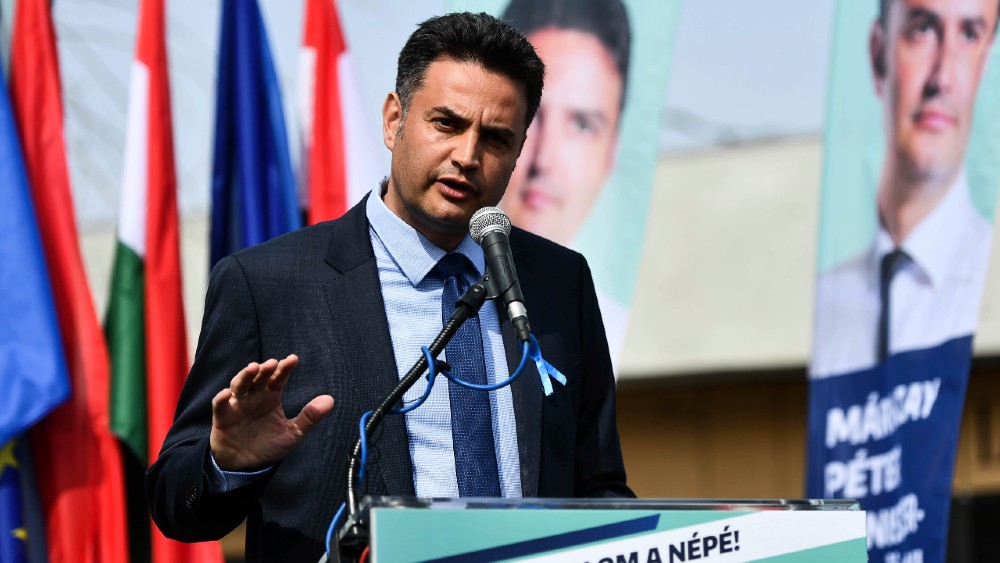
Hungary's joint opposition candidate for prime minister, Peter Marki-Zay, speaks at a campaign event, in Budapest, Hungary. /Anna Szilagyi/AP
Campaigning in what used to be called Moscow Square in Budapest, an opposition stronghold, Marki-Zay said on Tuesday that Russian President Vladimir Putin was rebuilding the Soviet empire and Orban "still cannot decide how to keep an equal distance from the killers and the victims."
Addressing cheering supporters, Marki Zay – a conservative small-town mayor and a Catholic father of seven – brought up the Hungarian uprising crushed by Soviet tanks almost 66 years ago, while taking a swipe at Orban.
"After 1956 there is still a Hungarian politician, who cannot state that we always must stand up against the aggressor," he said.
The anti-Orban coalition
Marki-Zay leads a coalition of six parties across Hungary's political spectrum that joined forces, galvanized by the possibility of ousting Orban.
Its members, from the leftist Democratic Coalition to the liberal Momentum and Jobbik, a far-right party turned moderate, have put most of their disputes aside for the campaign but policy differences may pose a challenge if Marki-Zay wins on Sunday.
He has promised to clamp down on corruption, gain access to European Union funds frozen by Brussels over the rule of law fight, and introduce the euro.
According to the latest poll by Zavecz Research, Fidesz led the opposition by three percentage points with 39 percent support. The think tank's director Tibor Zavecz said Fidesz appeared to have a better chance of winning, but much would depend on a last-minute mobilization of voters.
He said about 8 percent of the electorate, around 600,000 people, said they would cast a vote but still had no preferred choice.
Orban won the last three elections with ease, but Hungary has not always been so politically unified: elections in the 1990s and early 2000s tended to be much harder-fought.
If Orban is to win his fourth successive term against this grand coalition, he will have to prove himself more popular than all his opponents combined.
