- Home
- China
- World
- Asia-Pacific
- Americas
- Europe
- Middle-East and Africa
- Politics
- Business
- Opinions
- Tech & Sci
- Culture
- Sports
- Travel
- Nature
- Picture
- Video
- Live
- TV
- Specials
- Learn Chinese


Share







Copied
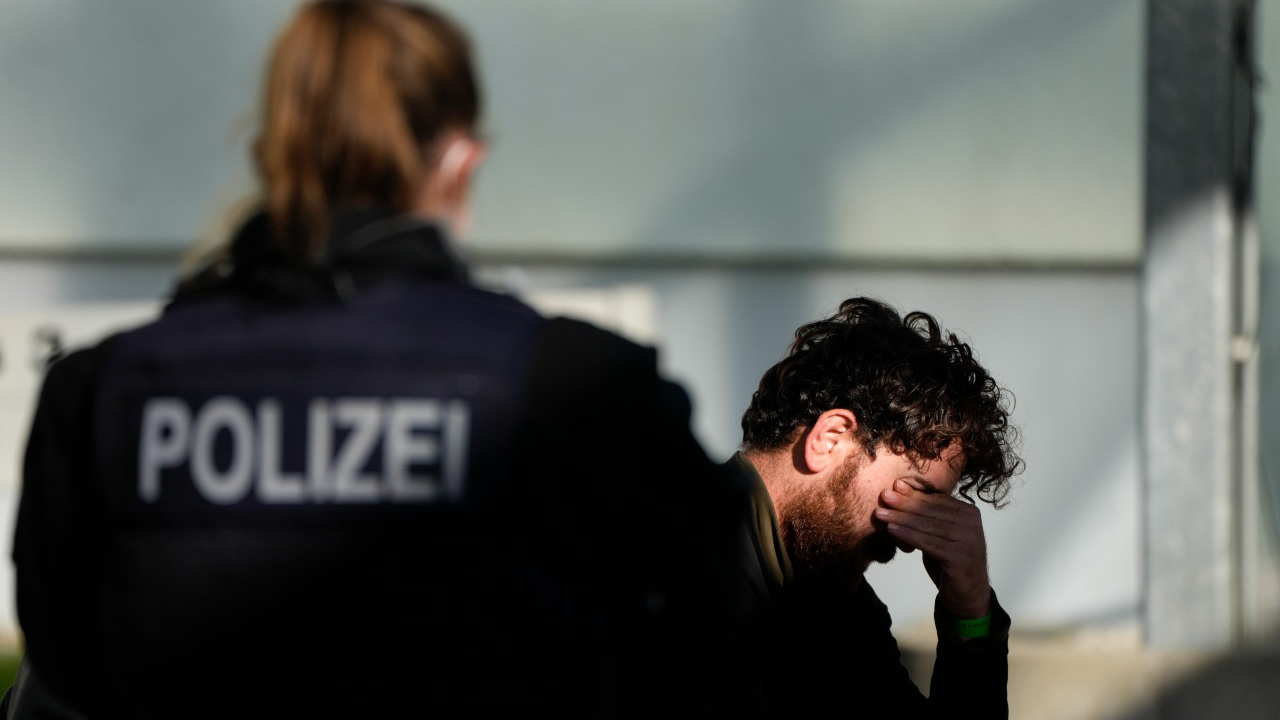
A federal police officer guards an arrested migrant at a police station in a German town that borders Poland. /AP/Markus Schreiber
German police said on Monday they registered more than 5,000 unauthorized border crossings last month by people who had arrived from Belarus, marking a significant uptick in the number of arrivals through a new and politically sensitive migration route.
Federal police said in a statement that in October 5,285 unauthorized entries "with a connection to Belarus" were recorded. That contrasts sharply with the 1,903 arrivals recorded in September, bringing the total so far this year to 7,832.
READ MORE:
Johnson and Macron hold talks over fishing row
COP26: What to expect from the event?
Police said last weekend alone, 597 people who entered illegally from Belarus were found on the German side of the border with Poland. Of those, 391 were Iraqi citizens while the remainder were from Syria, Iran and Afghanistan. Most had Belarusian visas or entry stamps in their passports.
Fellow European Union members Poland and Lithuania have been struggling to cope with an unusually high number of migrants arriving at their borders with Belarus in recent months.
The EU is accusing Belarus President Alexander Lukashenko's government of using them to destabilize the 27-nation bloc in retaliation for EU sanctions.
The influx has been causing concern in Germany, a favored destination for migrants reaching the EU.
Germany's outgoing interior minister recently proposed introducing joint German-Polish patrols on the border between the two countries to help clamp down on illegal crossings by migrants arriving from Belarus, but said no one has any intention of closing the frontier.
In a separate move, Bulgaria has deployed 350 troops and military equipment to strengthen controls along its borders with Turkey and Greece to prevent migrant inflows, the defence ministry said on Tuesday.
EU member Bulgaria, which borders Turkey and Greece to the south, has experienced a gradual rise in migrant arrivals since July.
Bulgaria has detained about 6,500 migrants, mainly from Afghanistan and Syria, in the first nine months of the year, three times more than in the same period a year ago, data from the border police showed.
The numbers are far below the inflows the Balkan country experienced during the migrant crisis in 2015, when it built a barbed-wire fence along its nearly 300km border with Turkey.
