- Home
- China
- World
- Asia-Pacific
- Americas
- Europe
- Middle-East and Africa
- Politics
- Business
- Opinions
- Tech & Sci
- Culture
- Sports
- Travel
- Nature
- Picture
- Video
- Live
- TV
- Specials
- Learn Chinese


Share







Copied
TOP HEADLINES
· A new COVID-19 variant has been identified in South Africa. The C.1.2 strain has been detected in most parts of the country and its transmission is relatively low, but scientists are concerned as it presents mutations similar to the Delta variant. Studies are continuing to see whether it is more contagious, or able to overcome the immunity provided by vaccines or prior infection.
· The EU has removed the U.S. from its safe travel list, recommending its member countries impose new travel restrictions on unvaccinated travelers from the country.
· In the same move, the EU removed Israel, Kosovo, Lebanon, Montenegro and North Macedonia from the list from where visitors are permitted into the bloc without restrictions, such as mandatory quarantine.
· UK and Republic of Korea drug firms GlaxoSmithKline and SK Bioscience announced on Tuesday they have begun a late-stage clinical study of SK's COVID-19 vaccine candidate in combination with GSK's pandemic vaccine booster.
· A study published in The Lancet Public Health journal found there was a huge drop in the number of organ transplants between 2019 and 2020, with 487 patients dying while waiting for a transplant compared with 372 in the year before.
· The French government announced the country will provide Africa with 10 million doses of AstraZeneca and Pfizer vaccines over the next three months.
· All vaccinated people in Czechia will be able to receive a booster COVID-19 vaccine from September 20.
· New Zealand reported 49 new cases on Tuesday, dropping for the second day in a row.
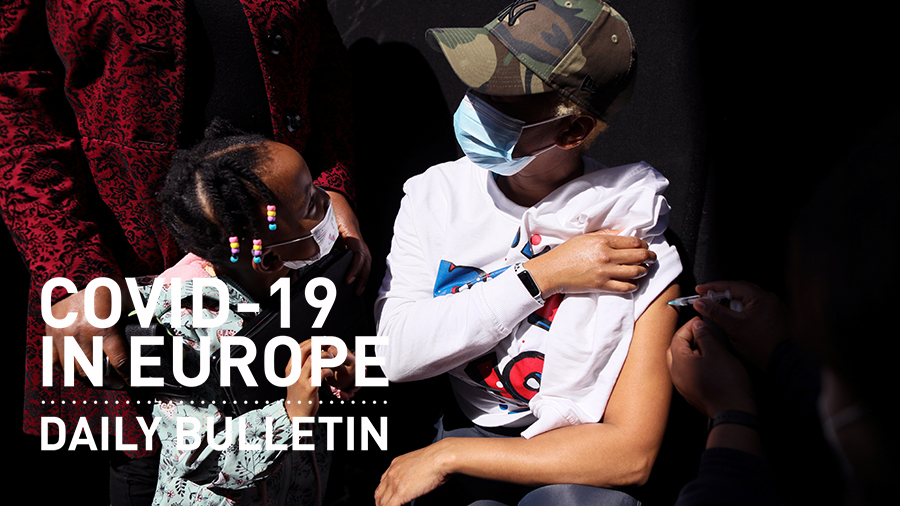
A woman receives the Johnson & Johnson COVID-19 vaccine while her daughter watches in Houghton, Johannesburg, South Africa. /Reuters/Sumaya Hisham
ACROSS EUROPE
Ryan Thompson in Frankfurt
Chancellor Angela Merkel is pushing for health pass rules, known locally as "3G rules," to be extended to long-distance travel within Germany.
"3G in long-distance trains and domestic flights can be a possible and sensible measure," said government spokesman Steffen Seibert on Monday in Berlin.
Similar rules are in place when traveling between cities in neighboring France.
Opposition politicians and even some within Merkel's own ruling coalition have criticized the proposed measure, saying it is not feasible to enforce.
The Deutsche Bahn (DB), Germany's main railroad operator, has occasionally faced issues with customer compliance to its coronavirus safety measures.
On Monday, a man was taken into custody for throwing stones at a DB train conductor who had asked the man to wear a face mask.
Ross Cullen in Paris
The French government is bringing an end to the COVID-19-related obligation to have to work from home for part of the week.
Only 14 percent of workers currently "telework" all week as more and more employees return to the office full time.
Work Minister Elisabeth Borne said: "We are going to introduce a new protocol that gives companies control over how they set out their own rules."
Meanwhile, France is on track to hit its target of 50 million first vaccinations in the coming days.
The government had aimed to hit the mark by August 31 but it is likely the number will be reached later this week, putting France ahead of countries such as the UK and Israel.
Penelope Liersch in Budapest
Those vaccinated in Czechia will be offered a COVID-19 booster shot from September 20.
The government's coronavirus task force said on Twitter that the extra jabs will be strongly recommended for people aged over 60 but they will also be available for anyone who has completed their vaccination program.
Pfizer and Moderna vaccines will be used as the booster shots and will be offered to those who completed their course of vaccination at least eight months ago, according to local media.
As of Monday, 5.73 million people have had at least their first dose of a two-shot vaccine, the majority received the Pfizer jab, with 197,254 people getting the one-dose vaccine made by Johnson & Johnson.
Czechia's Prime Minister Andrej Babis announced on television the government would also offer bonuses to doctors who convince people aged over 65 to have their first jab, in an effort to boost vaccination rates.
FROM OUR GLOBAL COLLEAGUES
CGTN Europe: EU advises ban on non-essential travel from the U.S.
CGTN China: Coronavirus may have come to Wuhan via cold chain: China CDC expert
CGTN Africa: Morocco registers 2,676 new COVID-19 cases
CGTN America: Hurricane Ida: Power outage, post-Katrina levee system tested
Sign up here to get the COVID-19 Europe bulletin sent directly to your inbox.
CGTN Europe has been providing in-depth coverage of the novel coronavirus story as it has unfolded.
