- Home
- China
- World
- Asia-Pacific
- Americas
- Europe
- Middle-East and Africa
- Politics
- Business
- Opinions
- Tech & Sci
- Culture
- Sports
- Travel
- Nature
- Picture
- Video
- Live
- TV
- Specials
- Learn Chinese

 Europe;
Share






Copied
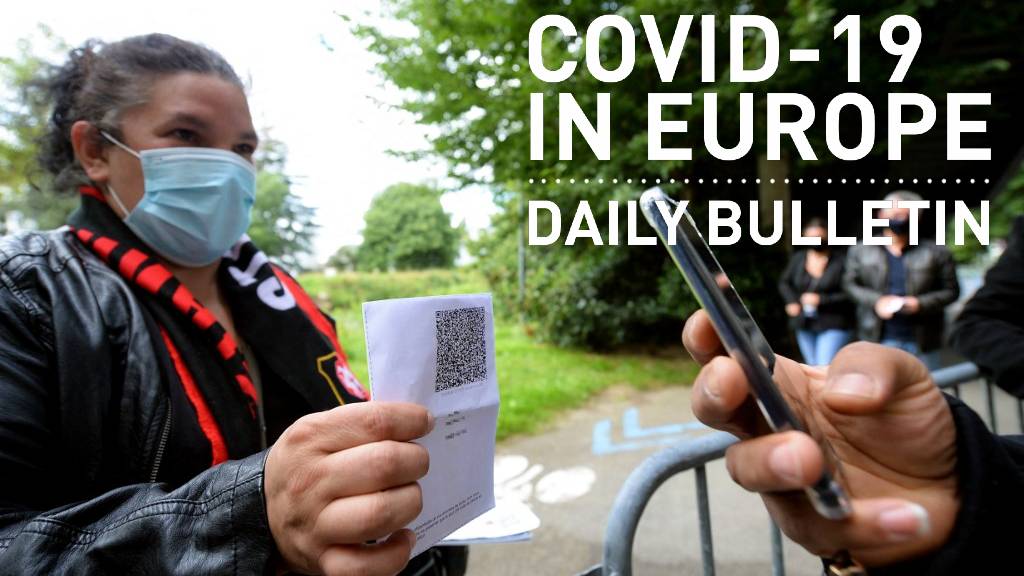
France's health pass goes into full effect from Monday. /Jean-Francois Monier/AFP
TOP HEADLINES
• People in France will from Monday have to show a health pass to enjoy normally routine activities like drinking a coffee on a terrace or travelling on an intercity train. President Emmanuel Macron has championed the plan as a way to reduce infections and encourage vaccination, despite four weekends of nationwide protests against the measures.
• Scotland's first minister Nicola Sturgeon admitted having "butterflies in my stomach" about lifting the majority of the country's coronavirus restrictions on Monday. "This is the right moment to remove legal restrictions to try to get that greater normality back in our lives," she told Good Morning Britain, "but with a big caveat that the virus hasn't gone away."
• The EU is set to review the list of states from which non-essential travel is allowed under coronavirus restrictions this week and may reassess the inclusion of the U.S., where the Delta variant is currently surging.
• New infections in Belgium are at around 1,600 per day, prompting Dutch police to step up checks on those crossing the border. Drivers entering the Netherlands without proof of their coronavirus status face fines of around $110.
• Six Berlin nightclubs opened this weekend without restrictions on social distancing and mask-wearing, as part of a pilot project to see whether PCR testing could prevent another closure of the city's nightlife venues. Some 20 clubs applied to take part in the project, dubbed Clubculture Reboot.
• Most people who had a third dose of Pfizer vaccine felt similar or fewer side effects compared to receiving the second shot, according to a new Israeli survey. Israel recently began offering booster shots to people over age 60 amid the spread of the Delta variant, effectively turning the country into a testing ground for a third dose.
• Describing the latest global review from the Intergovernmental Panel on Climate Change as a "code red for humanity," UN secretary general Antonio Guterres stressed that coronavirus recovery spending must be in line with international climate goals.
• Switzerland is considering a further relaxation of coronavirus measures in "the next few weeks" according to Health Minister Alain Berset, as a group of police threatened not to enforce the measures that restricted "fundamental rights disproportionately."
• Czechia has added the Netherlands, Estonia, Iceland and Madeira to its red coronavirus travel category, meaning travelers will be subject to double testing on entry.
• France is appealing for volunteer health workers to travel to its overseas territories after infections started to overwhelm hospitals on Guadaloupe and Martinique. Only 21 percent of the Caribbean islands' populations have had their first vaccine, while intensive care bed occupancy on Martinique is at 200 percent of normal capacity.
READ MORE
The Barbies inspired by front-line workers
AROUND EUROPE
Ross Cullen in Paris
The French government's coronavirus health pass enters into force from Monday in cafes, restaurants, trains, hospitals, and care homes. It means that anyone going into these places will have to provide proof that they have either been fully vaccinated, had a recent negative PCR test, or have recently recovered from the virus.
The pass comes in paper form or via a QR code on your phone as part of the government's track-and-trace app. Cultural and sporting venues like museums and swimming pools have had the health pass in use from July 21. On August 30, hospitality staff and train staff will have to start using the pass, as will medical workers from September 15.
Children will not need to scan their QR code to access schools but they will need to do so to access hospitality, sporting or cultural venues from September 30.
Toni Waterman in Brussels
Pandemic-induced teleworking has helped drive road fatalities in Brussels to a decade low: in the first six months of the year, four deaths were reported. Up to 60 percent of Belgians have worked from home during the pandemic. The government is continuing to encourage telework and staggered shifts as the Delta variant spreads.
The number of new infections has hit around 1,600 per day, prompting police in the Netherlands to step up border checks on those crossing in from Belgium. Police are now stopping drivers to check for a COVID pass or a negative test. Those found without the proper paperwork are being fined $110.
Nawied Jabarkhyl in London
Almost all coronavirus restrictions in Scotland have now been removed. There's no longer a need to socially distance in most places and all businesses and hospitality venues have been allowed to reopen. But, unlike rules in England, face coverings are still mandatory in public places and on public transport.
The UK's health secretary has written to the country's competition watchdog asking it to look into the cost of PCR testing. The tests are mandatory for foreign travel and usually cost around $100. But some private firms are reportedly offering them for much higher, leading to fears that many people could be priced out from accessing them.
FROM OUR GLOBAL COLLEAGUES
CGTN Europe: Did social media help us during lockdown? - The Agenda explainer
CGTN China: COVID-19 origin: How safe is the Wuhan Institute of Virology?
CGTN America: Colombia begins lifting COVID-19 restrictions
CGTN Africa: Somalia receives 108,000 more doses of COVID-19 vaccines
Sign up here to get the COVID-19 Europe bulletin sent directly to your inbox.
CGTN Europe has been providing in-depth coverage of the novel coronavirus story as it has unfolded.
