- Home
- China
- World
- Asia-Pacific
- Americas
- Europe
- Middle-East and Africa
- Politics
- Business
- Opinions
- Tech & Sci
- Culture
- Sports
- Travel
- Nature
- Picture
- Video
- Live
- TV
- Specials
- Learn Chinese

 Europe;
Share







Copied
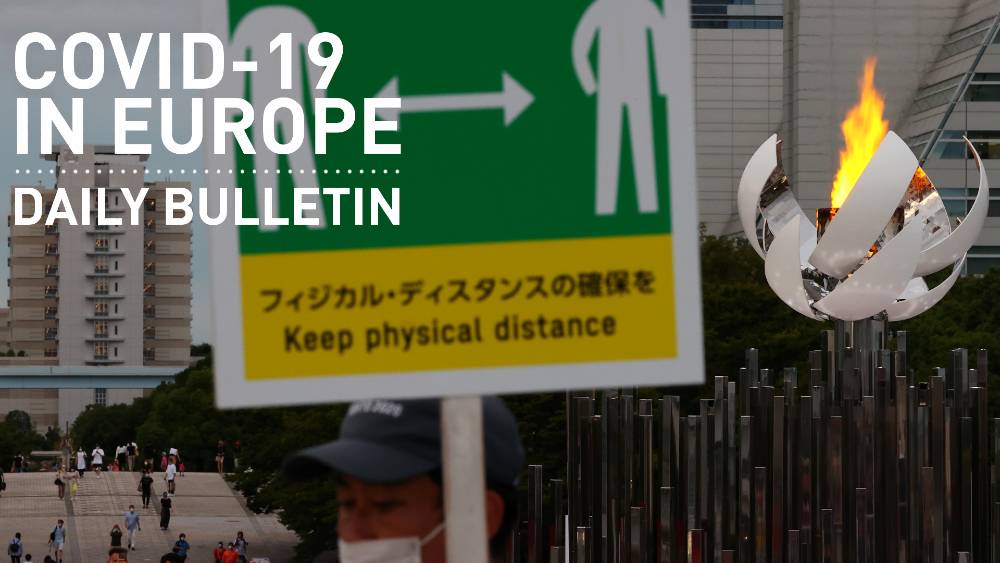
On the penultimate day of the Tokyo Olympics athletes and staff are reminded of pandemic restrictions / Reuters / Kim Kyung-Hoon
TOP STORIES
• Charities in Russia's second city St Petersburg have started an initiative to vaccinate homeless people using a single-shot COVID-19 jab called 'Sputnik V Light.' The city has at least 100 vaccination sites, but only Russian citizens with valid ID and health insurance can access them, locking many homeless people out.
• COVID-19 increases patients' risks for heart attack and stroke, according to research undertaken in Sweden and published in The Lancet. In the week following a COVID-19 diagnosis, the risk of a first heart attack went up by between three and eight times, and the risk of a first stroke rose by between three and six times. The Umea University study did not include COVID-19 patients who had previously suffered such episodes.
• Could annual flu vaccines stop the worst COVID-19 symptoms, and reduce the risk of death? That's what a peer-reviewed study from the University of Miami has suggested. Out of close to 75,000 COVID-19 patients studied, the half who had received a flu jab were less likely to need intensive care, or develop dangerous blood clots. The researchers made clear it was not proof flu jabs prevented severe COVID-19, but they said it proves the need to investigate further.
• Germany has extended its quarantine-on-arrival rules for visitors from three regions of southern France, citing rising case numbers. Arrivals from Occitanie, Provence-Alpes-Côte-d'Azur, and Corsica must isolate for 10 days if they do not have an EU pass confirming full vaccination.
• UK Prime Minister Johnson will not isolate, despite a member of his staff testing positive for the virus during a trip to Scotland. The visit was seen as an important political move for Johnson, but he has received criticism for continuing to meet people around the country. The PM's office said he was not a "close contact" with the person who had tested positive.
• Studies are under way across Europe into reports of COVID-19 vaccines affecting some women's menstrual cycles. The EU's drug regulator said no causal link had been found so far, but the European Medicines Agency said it had asked manufacturers for more information. Anyone wishing to take part in a study can email periodstudy@imperial.ac.uk for more information.
• Germany is making early preparations for another winter COVID-19 surge, including discussion of a policy like those seen in France, the UK, and other nations that would restrict access to gatherings and businesses for people who refuse a vaccine.
• China on Saturday reported 107 new confirmed coronavirus cases in the mainland for August 6, compared with 124 a day earlier, according to the National Health Commission. Of the new infections, 75 were locally transmitted, the health authority said. That compares with 80 local cases a day earlier. Most of the local cases were in the eastern province of Jiangsu.
READ MORE
The Barbies inspired by front-line workers
Second-hottest July on record for Europe
UK unveils COVID-19 travel rule changes
AROUND EUROPE
Hungary
After racing ahead of other EU countries to start rolling out vaccines at the beginning of the year, Hungary is now the first to offer booster jabs. No matter what vaccine they've had, anyone is now technically eligible for a third shot, but most will need to wait four months from their second vaccination.
The system relies on patients asking for a booster, and doctors deciding on a case-by-case basis. This has been criticized by some for a lack of guidance, but as doctors told CGTN Europe, there is a need to prioritize the whole population receiving at least one dose of vaccine.
France
More than 100 protests are organized this weekend, the fourth consecutive weekend of mass protests against the introduction of a health pass - or pass sanitaire - as well as President Macron's calls urging French citizens to get vaccinated.
From Monday the proof of vaccination, or negative test result, will be needed to access many businesses, from cafes or restaurants to large gatherings for any purpose, or municipal travel like trains or buses.
Police said they expect between 160,000 and 205,000 people to take to the streets of cities across France.
Iolo ap Dafydd in UK
Wales has joined England in dropping UK pandemic restrictions. First Minister Mark Drakeford announced the country is now on "level zero" COVID-19 alert. He says it is largely down to a fall in new cases, due to the speed and efficiency of vaccinations.
Seventeen months after Wales's first lockdown, nightclubs will reopen and meeting indoors between people of different households is permitted.
Face masks are still required in some public indoor places, but not in pubs, restaurants, cafes and schools. Drakeford warned against a "free-for-all" and encouraged people to remain cautious.
The UK's Prime Minister Boris Johnson isn't expected to self isolate after a member of his staff tested positive for the virus, after a two-day visit to Scotland. A Downing Street spokesperson denied Johnson was within two meters of the staff member, despite traveling on the same plane.
FROM OUR GLOBAL COLLEAGUES
CGTN Europe: Meet the new Barbies inspired by pandemic heroes
CGTN China: China calls for unity, making vaccines global public good
CGTN America: Colombia begins lifting COVID-19 restrictions
CGTN Africa: World Bank to finance Ghana's COVID-19 vaccine rollout
Sign up here to get the COVID-19 Europe bulletin sent directly to your inbox.
CGTN Europe has been providing in-depth coverage of the novel coronavirus story as it has unfolded.
