- Home
- China
- World
- Europe
- Politics
- Business
- Opinions
- Tech & Sci
- Culture
- Sports
- Travel
- Nature
- Picture
- Video
- Live
- TV
- Specials

 Europe;
Share







Copied
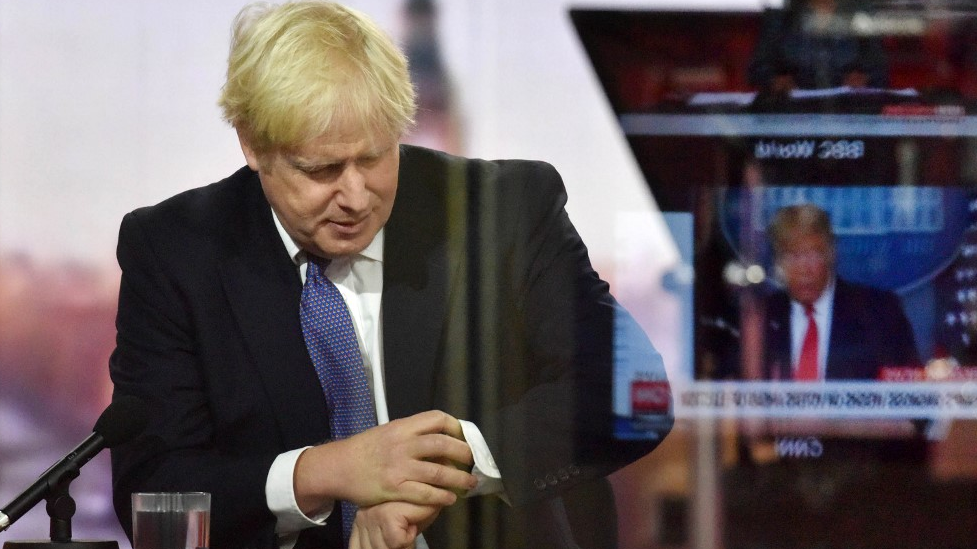
Boris Johnson, pictured here just ahead of his Sunday morning TV interview. /AFP/Jeff Overs/BBC
The UK "can prosper mightily" without a post-Brexit trade deal with the European Union, according to its prime minister Boris Johnson.
Johnson said in a television interview with the BBC on Sunday that he believes a deal is still "there to be done." He had agreed to prolong negotiations in a video call with European Union's President Ursula von der Leyen on Saturday.
But he warned that his government was "utterly serious about needing to control our own laws and our own regulations," including its fisheries policy and access to the UK's rich fishing waters.
The UK formally left the EU in January 2020 but remains under most of the bloc's rules until the end of the year under the terms of the transition period.
Talks have continued between the UK and the EU throughout the year to try to reach agreement before the transition period ends on 31 December, but have stalled on several occasions, with both parties admitting that significant obstacles stood in the way of a successful deal.

CLICK: HOW AI WILL CONTROL THIS BOAT DURING ITS 5,000 KILOMETER VOYAGE
Johnson and von der Leyen put out a joint statement after their conversation on Saturday, saying they had asked negotiators to "work intensively in order to try to bridge those gaps."
If the UK and EU do not come to an agreement it would be in a similar situation on 1 January as countries such as Australia, which also does not have a free-trade agreement with the EU and instead does the bulk of its trade according to World Trade Organzation rules.
But Johnson thinks the UK can cope if a deal isn't agreed in time.
"I don't want the Australian, WTO-type, outcome particularly, but we can more than live with it. I think that we can prosper mightily under those circumstances," he added.
The Confederation of British Industry last week called for a deal to be done, saying that "it will provide the strongest possible foundation as countries build back from the pandemic."