By continuing to browse our site you agree to our use of cookies, revised Privacy Policy and Terms of Use. You can change your cookie settings through your browser.
1100-year-old Viking 'portrait' found hidden in plain sight

Share







Copied

The 10th-century gaming piece which is believed to be the first portrait of a Viking. /Camille Bas-Wohlert/AFP
Denmark's National Museum has unveiled what it describes as the first "portrait" of a Viking: a miniature 10th-century figurine depicting a man with an imperial moustache, braided beard and neatly-groomed hairstyle.
Carved out of ivory walrus tusk, the partially damaged representation of a head and torso measures just three centimeters (1.2 inches).
"If you think of Vikings as savage or wild, this figure is proving the opposite, actually. He is very well-groomed," curator Peter Pentz explained.
"He has a center parting up to the top of his head, and then in the neck his hair is cut."
The figurine also has a side wave that leaves the ear visible, and, in addition to a large moustache and a long, braided goatee, he also has sideburns.
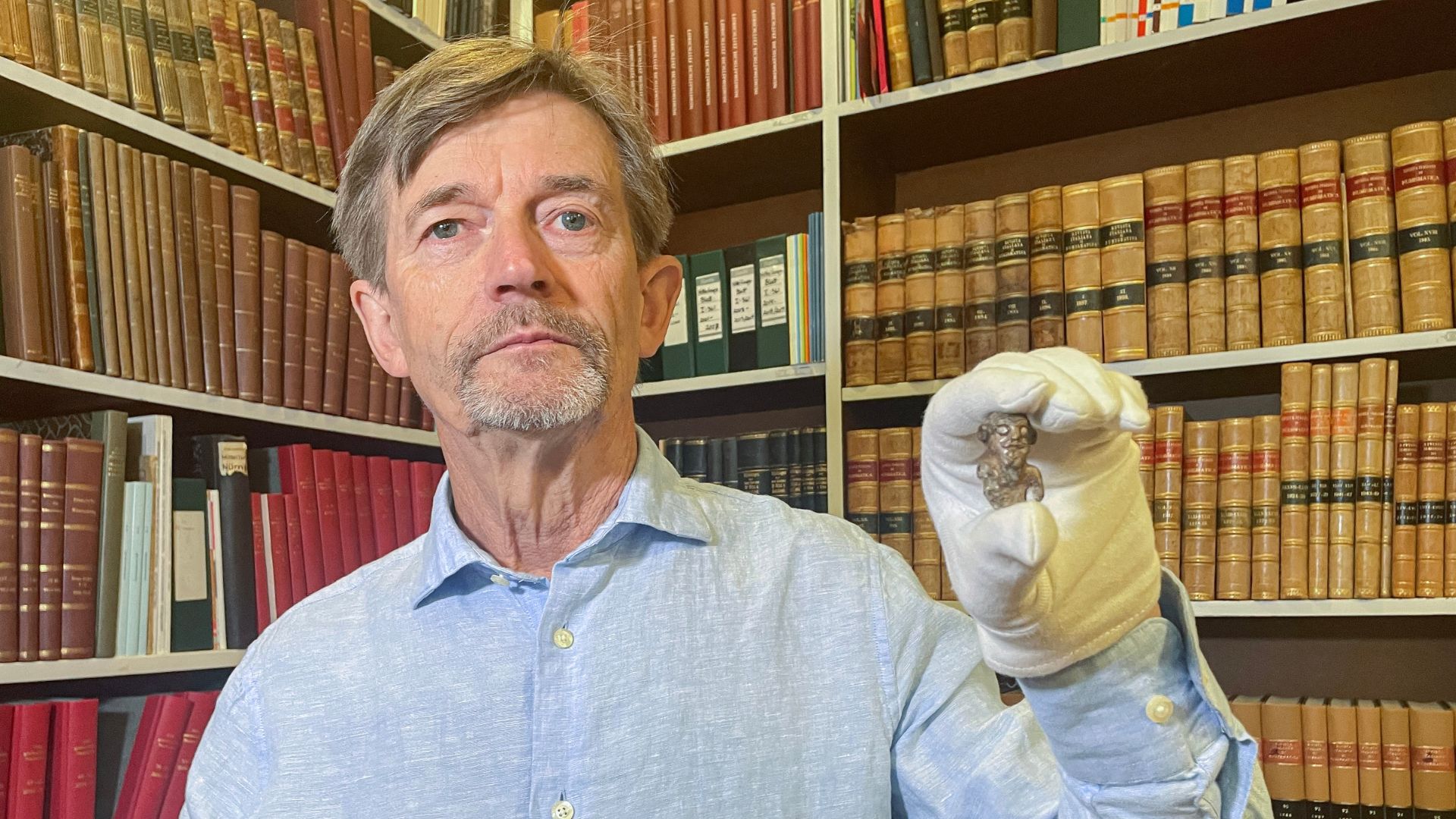
Denmark's national museum curator Peter Pentz with the figurine. /Camille Bas-Wohlert/AFP
During the Viking era, beautiful hair was a sign of wealth and status, Pentz explained.
"A hair design like his, which is very neat - you can see a little curl or tuft of hair running over the ears - (suggests) this guy is at the top."
"He could be the king himself, King Harald Bluetooth."
The artwork, which is believed to be an ancient board game piece representing a king, was originally found in the Oslo fjord in Norway in 1796.
It has been tucked away and forgotten in the archives of Denmark's National Museum ever since.
When Pentz stumbled upon the figurine in the museum's large collections a few years ago, he said it felt like the Viking was looking right at him.
Its detailed carvings contrast with other existing depictions of Vikings - on things like coins - that feature little or no individual details or facial expressions.
Viking Age art is known for its characteristic animal motifs, but rarely portrays humans.
"This is the first thing that comes close to a portrait from the Viking period that I've seen," Pentz said.
"The most surprising thing for me is his expression. Most Viking renderings of human figures are quite simple, and they are not really human-like," he said.
But this one is unique with its attention to detail.
"He looks devilish, some people say. But I think he looks more like he's just been telling a joke or something like that. He's smiling."
Search Trends
SITEMAP
Copyright © 2023 CGTN. 京ICP备16065310号

Disinformation report hotline: 010-85061466
SITEMAP
Copyright © 2023 CGTN. 京ICP备16065310号
Disinformation report hotline: 010-85061466