- Home
- China
- World
- Asia-Pacific
- Americas
- Europe
- Middle-East and Africa
- Politics
- Business
- Opinions
- Tech & Sci
- Culture
- Sports
- Travel
- Nature
- Picture
- Video
- Live
- TV
- Radio
- Specials
- Learn Chinese

 Europe;Germany
Share







Copied
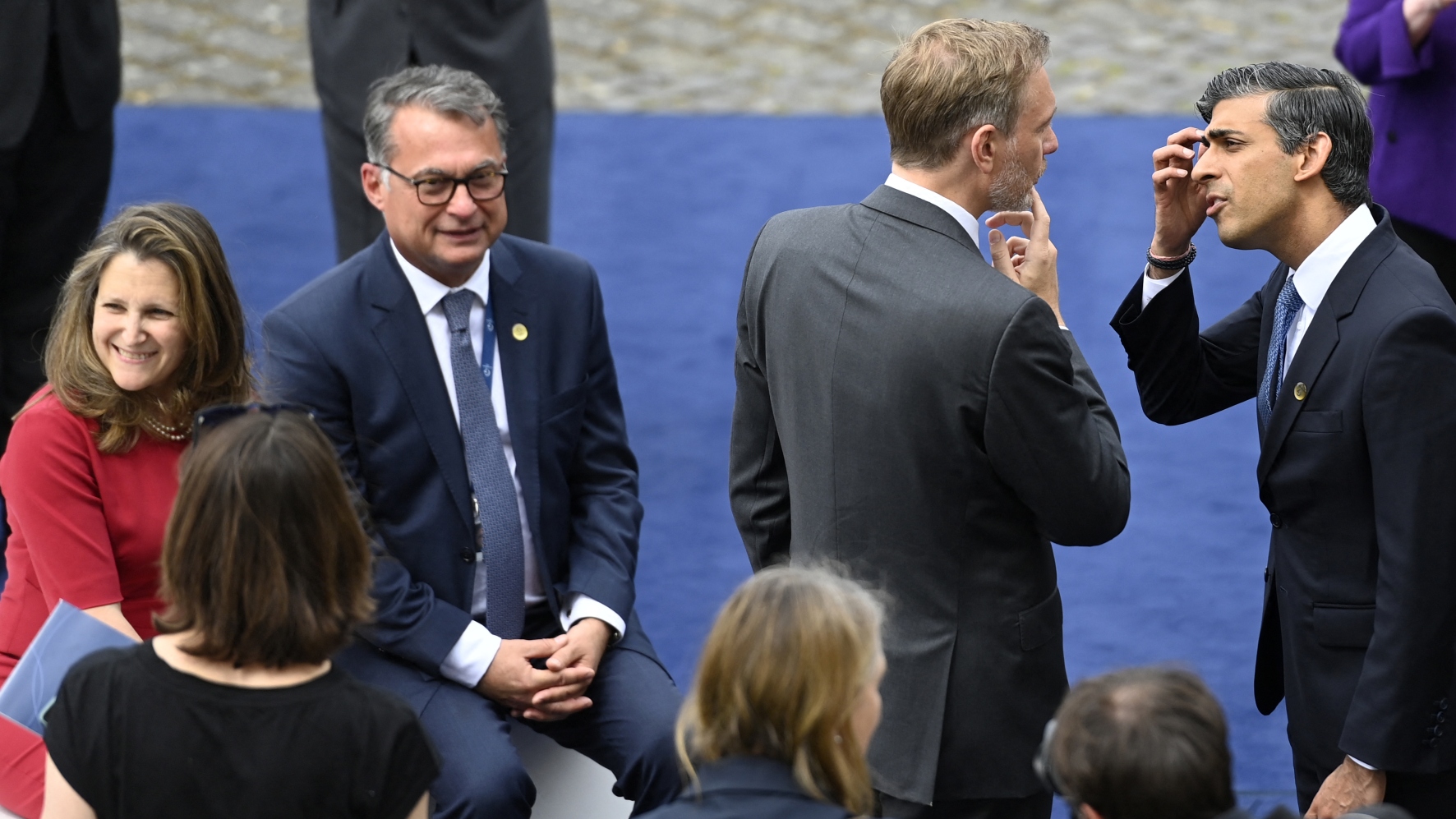
G7 ministers are hoping to sign off on a financial support package for Ukraine at a three-day meeting. /Ina Fassbender/AFP
G7 Finance Ministers are meeting in Germany as concerns grow about the health of the global economy. The three-day meeting comes as inflation reaches record highs in the U.S. and Europe.
The wider impact of the war in Ukraine is also expected to dominate discussions, with the conflict expected to put pressure on food prices with millions of tonnes of grain stuck in Ukrainian ports.
"Russia's unprovoked criminal attack on Ukraine has, of course, also resulted in additional risks for the development of the global economy," said German Finance Minister Christian Lindner. Moscow maintains it started the conflict in response to the "unacceptable threat" posed by NATO's military development in eastern Europe.
"This concerns inflation, but also the failure to recover from the pandemic. We will therefore have to discuss what we can do together in each of our areas of responsibility to avoid stagflation scenarios," added Lindner.
READ MORE
McDonald's leaves Russia for good
His warning echoes similar statements made by U.S. Secretary of the Treasury Janet Yellen. She told reporters her G7 counterparts were aware of the challenges facing governments and policymakers.
"The economic outlook globally is challenging and uncertain, and higher food and energy prices have stagflationary effects – namely, depressing output and spending and raising inflation all around the world," she said.
Tough stance against Russia
The U.S. has also signaled it is not prepared to extend a license that allows Russia to pay U.S. bondholders despite a ban on transactions with the Russian Finance Ministry, central bank, or national wealth fund. The exemption is due to expire on May 25. Not extending it would likely force Russia to default on its debts for the first time in over 100 years.
"When we first imposed sanctions on Russia, we created an exemption that would allow a period of time for an orderly transition to take place, and for investors to be able to sell securities," Yellen said. "The expectation was that it was time-limited. So, I think it's reasonably likely that the license will be allowed to expire."
Ukraine rebuild
With the Ukrainian government's revenues collapsing as a result of the war, G7 countries are also looking at providing financial grants to help prop up Kyiv's economy.
Lindner said he was confident a deal could be struck to help give Ukraine a financial lifeline.
"We see numbers in the double-digit billions which are needed for the foreseeable future and I'm quite optimistic that we will be able at this G7 meeting to raise funding which allows Ukraine to defend itself over the next months," he said.
'Not legal' for U.S. to seize Russian assets
Kyiv has also called for Western countries to seize assets owned by the Russian Central Bank and to give them to Ukraine to help with reconstruction efforts. But while emphasizing the need to help provide funding to rebuild the war-torn country, Yellen said the process of seizing assets faced legal restrictions.
"With the U.S. and our partners, it's estimated (we) have blocked around $300 billion of those assets," she said. "It's very natural that given the enormous destruction in Ukraine and huge rebuilding costs that they will face, that we will look to Russia to help pay at least a portion of the price that will be involved.
"That said, it would not be legal now, in the U.S. for the government to seize those statutes. It's not something that is legally permissible. Other countries have legal issues around it as well."
