- Home
- China
- World
- Asia-Pacific
- Americas
- Europe
- Middle-East and Africa
- Politics
- Business
- Opinions
- Tech & Sci
- Culture
- Sports
- Travel
- Nature
- Picture
- Video
- Live
- TV
- Radio
- Specials
- Learn Chinese

 Europe;Ukraine
Share







Copied
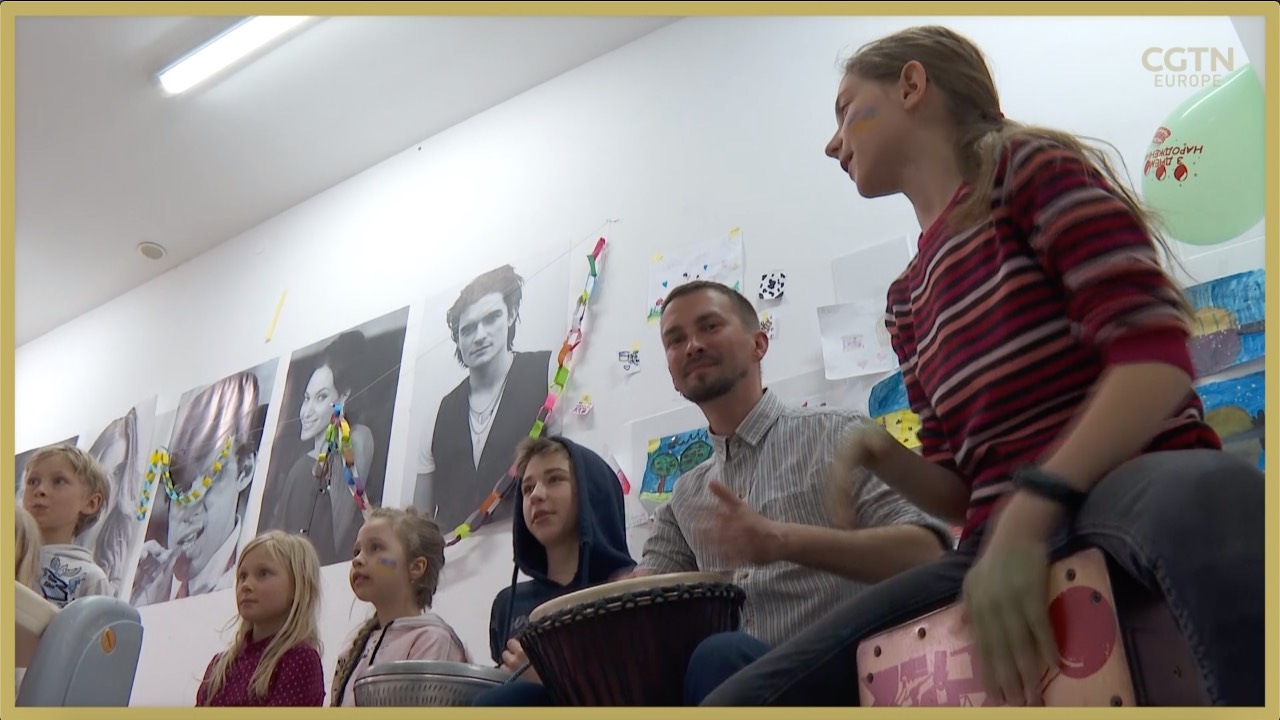
More than 7.7 million people are estimated to have been displaced within Ukraine because of Russia's military offensive, after having to flee their homes, the United Nations said on Thursday.
This is in addition to the more than five million Ukrainians who have left the country entirely since Moscow's troops started their campaign on February 24.
Millions of children's lives have been uprooted as the ongoing fighting has forced them to flee, often exposing them to terrifying experiences.
Those who have left their homes are now in precarious situations in new towns and cities, where volunteers are trying to help the children through the conflict.
READ MORE
See Odesa's catacombs, ready for Russian attack
What counts as a chemical weapon?
How Zoe Reed builds bridges between cultures
In western Ukraine, the town of Uzhhorod has opened up its community center to children. Each day, from morning until night it offers drop-in sessions of different crafts and music.
Children can be seen beating the drums and strumming the guitars at these sessions. They seem to be a lot of fun but also noisy and chaotic, much like the last few weeks for these children.
This is a space for kids to be kids, however they may choose to express that, whether it is through music, dance or drawing.
"The music makes them dance, they're big fans of the musical instruments," says volunteer Yulia Vladimirovna.
"We've got a great creative process going on here. Magicians come and clowns work with the children. People from all over Ukraine come."
'We help kids and they help us'
Hundreds of thousands of children have arrived in western Ukraine in recent weeks. It is now a part of the country sheltering vast numbers of internal refugees because of its relative peace
Dzvinka Syvyk is working for the UN's children's agency Unicef. Most days you can find her inside a huge inflatable tent that serves as a play zone for the displaced children who now call Uzhhorod their home.
"Some of them are really happy now, and some are not – some of them are really scared," says Syvyk. "And they're telling us about how do they feel, what do they want, what are they afraid of."
The children are encouraged to draw their experiences, to try and express and come to terms with what they have seen over the last few weeks. It is no surprise that many of the drawings illustrate guns and tanks.
Syvyk herself left Kyiv, her home for the last 15 years, at the start of the conflict.
"We help each other. We help kids and they help us," she says. "It's more difficult to stay home and do nothing. And if you have some purpose with your life now, it's very helpful for us as well. I think less about what is happening now if I have something to do. This is my way of surviving this war."
Even in these difficult times, Syvyk has hope for what may lie ahead.
"When I see children smiling, when I see they are smiling no matter what, I know that we will survive and we will rebuild our country," she says.
For millions of children the future is uncertain and millions still do not have a permanent home.
