- Home
- China
- World
- Asia-Pacific
- Americas
- Europe
- Middle-East and Africa
- Politics
- Business
- Opinions
- Tech & Sci
- Culture
- Sports
- Travel
- Nature
- Picture
- Video
- Live
- TV
- Radio
- Specials
- Learn Chinese


Share







Copied
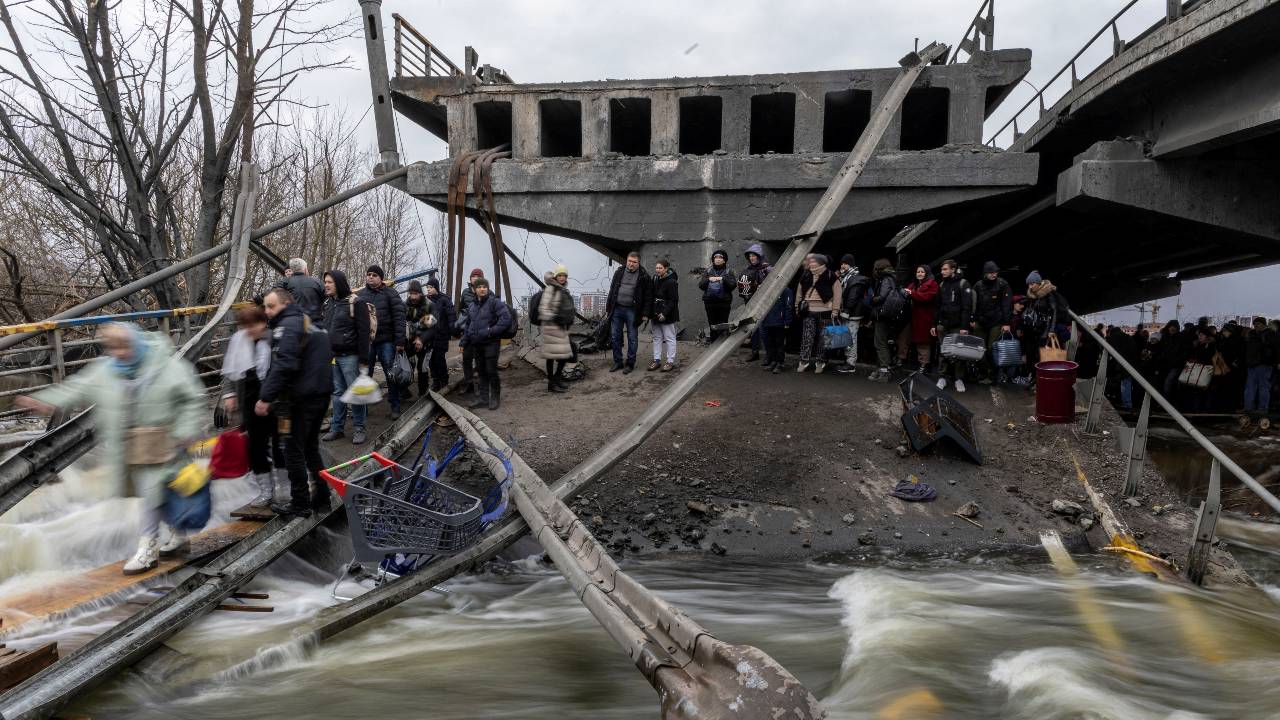
Local residents cross a destroyed bridge as they evacuate from the town of Irpin. /Carlos Barria/Reuters
MAIN HEADLINES
• Ukraine has suffered about $10 billion in damage to buildings and roads since Russia began the conflict, the country's infrastructure minister Oleksander Kubrakov said.
• A third round of talks concluded on Monday between Russian and Ukrainian negotiators. The adviser to Volodymyr Zelenskyy tweeted "small positive subductions in improving the logistics of humanitarian corridors" had been made.
• Leonid Slutsky, chairman of the Russian State Duma International Affairs Committee, said Russia hopes to successfully evacuate people through humanitarian relief channels as soon as possible. Further negotiations with Ukraine will be held as soon as possible, but Russia has no illusions about the outcome of the next round of talks.
• Moscow has promised a ceasefire and the opening of six humanitarian corridors in several Ukrainian cities, including the capital, at the request of French President Emmanuel Macron. However, the routes would lead directly into Russian and Belarusian territory. Kyiv dismissed the move as a manipulative and "immoral stunt."
• Ukrainian President Volodymyr Zelenskyy said in a public address on Sunday he would punish Russian troops who committed atrocities in Ukraine, adding that the "only quiet place" that awaits them is the grave. "We will not forgive. We will not forget," he said.
• Dozens of civilians were reportedly killed in the battle for Chernihiv in the north, while Ukraine's military said it was fighting "fierce battles" near the southern city of Mykolayiv, close to the strategic port city of Odesa.
• A UN report said hundreds of thousands of people inside Ukraine were cut off from life-saving aid due to the military encirclement of cities.
READ MORE
• U.S. Secretary of State Antony Blinken has sought to reassure Washington's NATO allies in the Baltic region, where Lithuanian President Gitanas Nauseda warned that Putin "will not stop in Ukraine" in his plans to redraw Europe's borders.
• British Prime Minister Boris Johnson, who met with his Dutch and Canadian counterparts in London on Monday, will set out an energy supply strategy in the coming days as the fallout of the Ukraine conflict pushes oil and gas prices to multi-year highs.
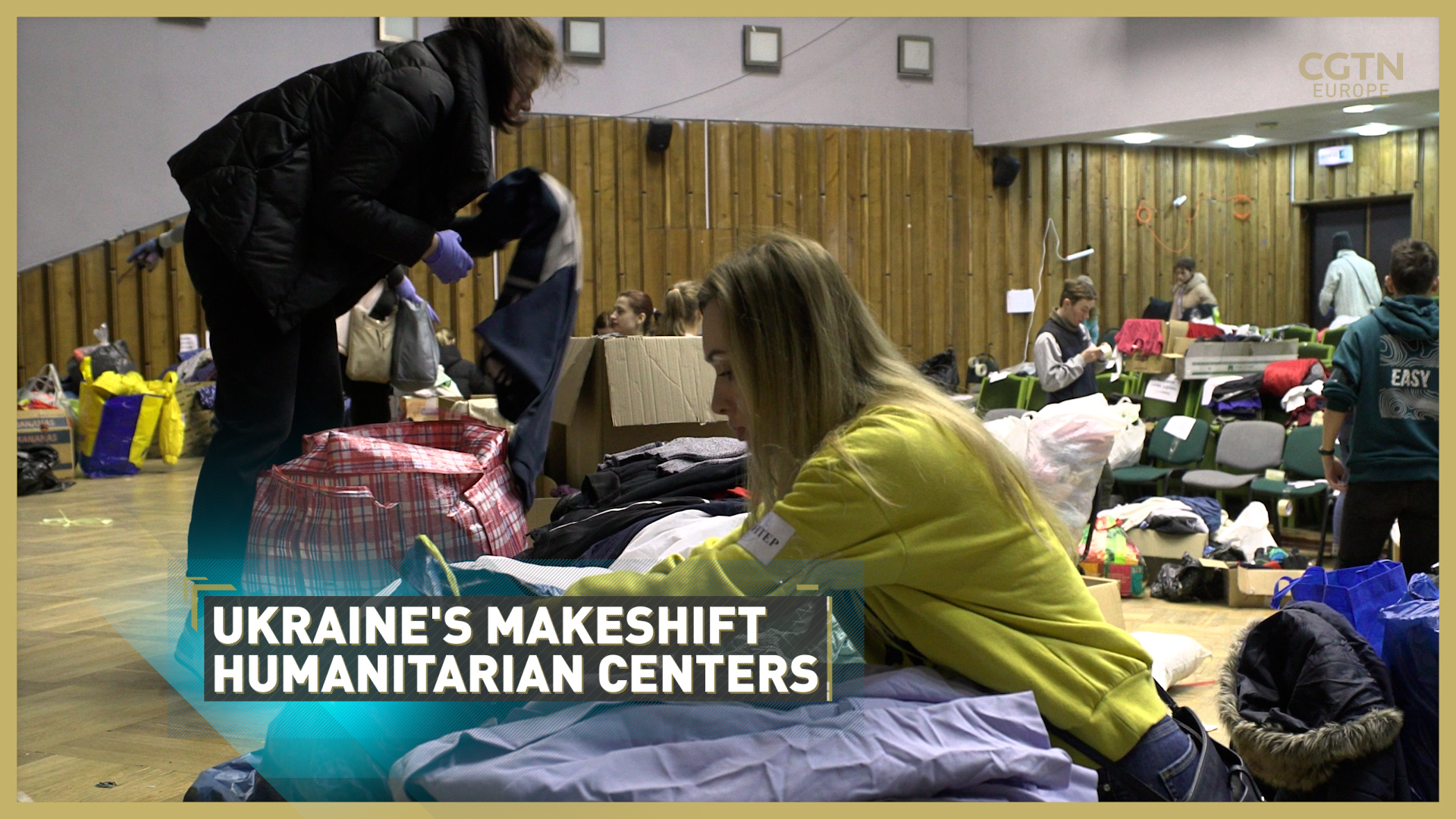
• Lviv's mayor has appealed for international help as displaced people continue to surge into the western Ukrainian city. Some 200,000 internally displaced persons are there now, with an estimated 50,000 more passing through its railway station everyday.
• Russia has stuck to its position on the Iran nuclear deal of linking the revival of a 2015 agreement to Western sanctions over Ukraine, saying the pact cannot discriminate between participants.
• The U.S. has given a "green light" for Poland to supply Kyiv with fighter jets, a decision which Moscow said could drag NATO members into the conflict.
• More than 20,000 international volunteers have joined the fight against Russian forces, Ukrainian Foreign Minister Dmytro Kuleba has announced.
• As many as five million Ukrainians are expected to flee from their country if Russia's bombing of Ukraine continues, the EU's top diplomat Josep Borrell has said.
IN DETAIL
Humanitarian corridors
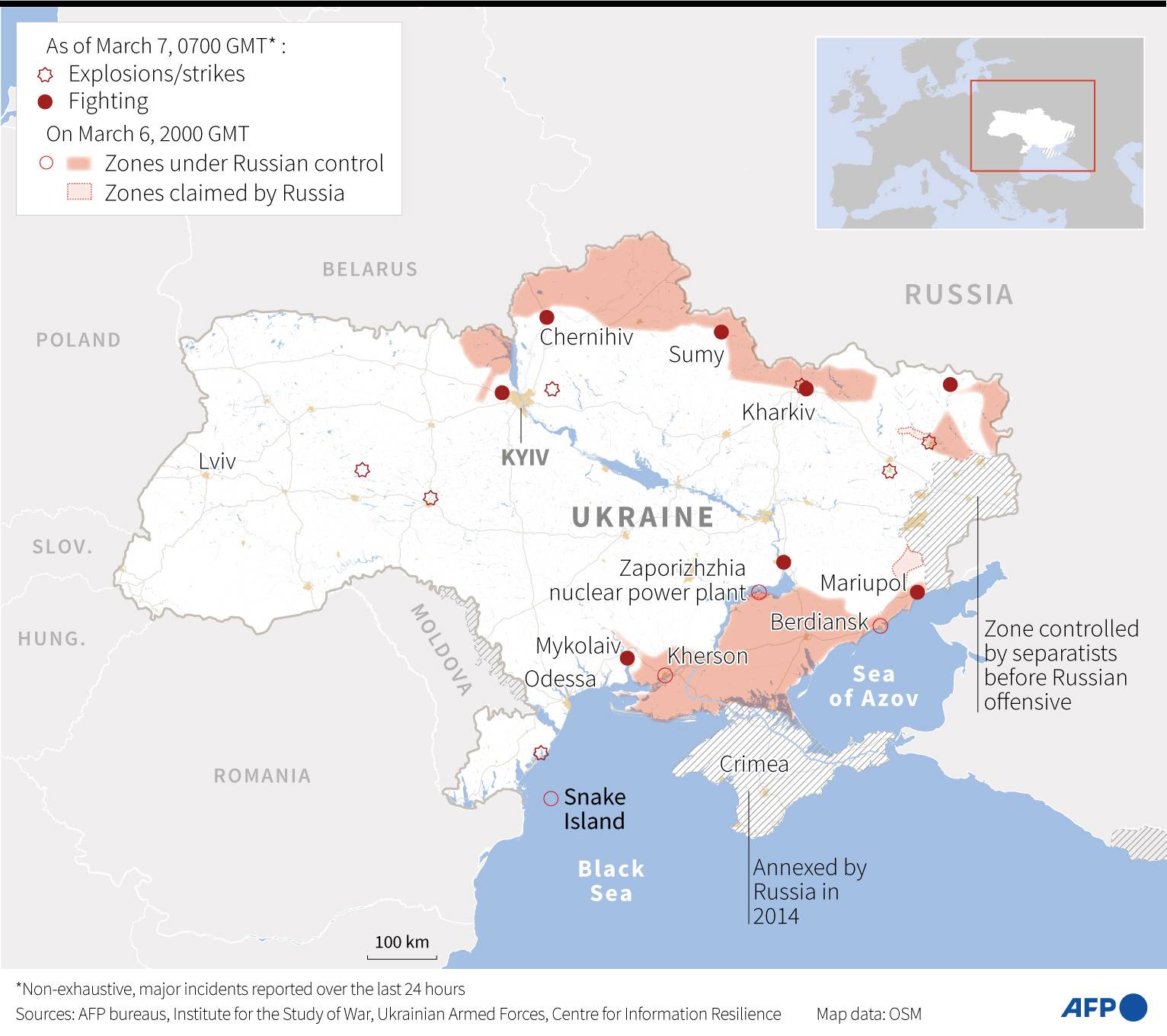
Russia has announced new "humanitarian corridors" to transport Ukrainians in besieged cities - to Russia and its ally Belarus, a move denounced by Kyiv.
The announcement came after two days of failed ceasefires to let civilians flee the southern city of Mariupol, where hundreds of thousands of people are trapped without food and water.
The new corridors are planned to be opened at 10 a.m. Moscow time (0700 GMT) from the capital Kyiv and the eastern cities of Kharkiv and Sumy, as well as Mariupol, Russia's defense ministry said.
The corridor from Kyiv would lead to Belarus, according to maps published by the RIA news agency, while civilians from Kharkiv would be permitted to go only to Russia. The defense ministry said it would also allow airlifts of Ukrainians from Kyiv to Russia.
"Attempts by the Ukrainian side to deceive Russia and the whole civilized world ... are useless this time," the ministry said.
A spokesperson for Zelenskyy called the move "completely immoral" and said Russia was trying to "use people's suffering to create a television picture."
"This is one of the problems that is causing the humanitarian corridors to break down. They [Russia] seem to agree to them, but they themselves want to supply humanitarian aid for a picture on TV, and want the corridors to lead in their direction."
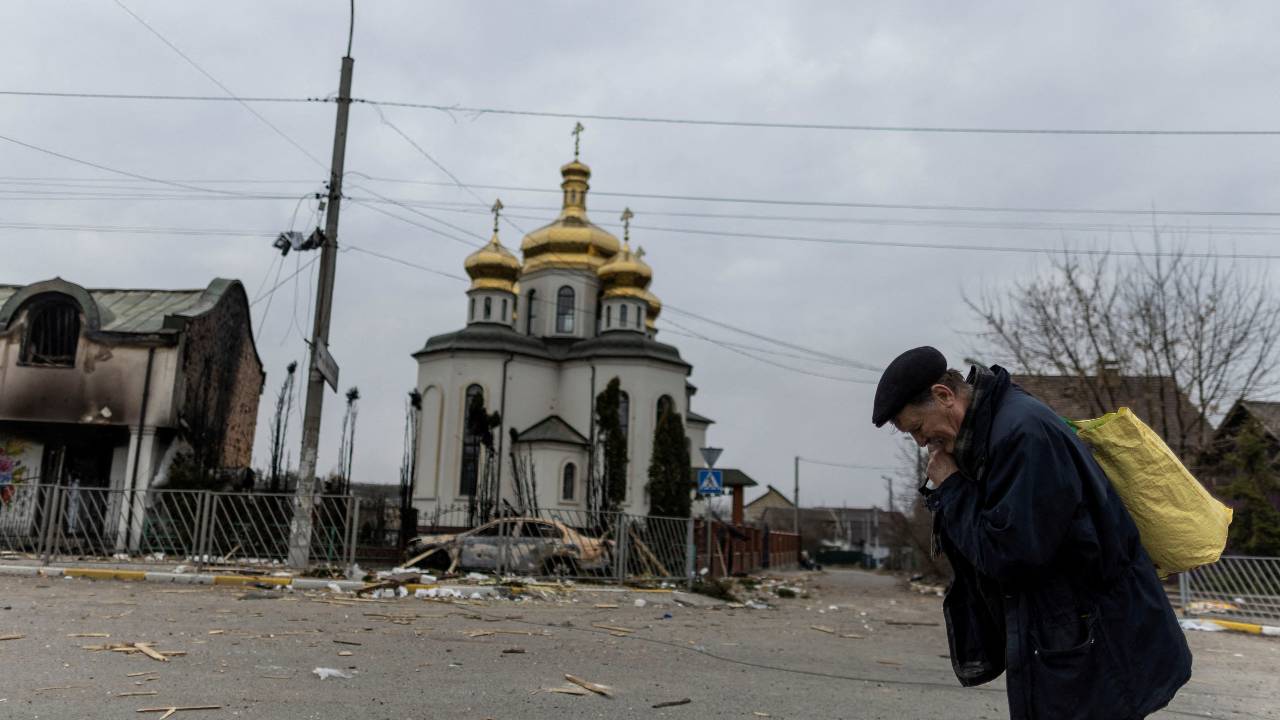
Heavy shelling continued to hit the city of Irpin just outside Kyiv. /Carlos Barria/Reuters
Energy markets
As sweeping sanctions isolate Russia to a degree never before experienced by such a large economy, oil prices are also soaring. Rising to the highest levels since 2008 in Asian trade, the surge in price came after the Biden administration said it was exploring banning imports of Russian oil, which accounts for 7 percent of global supply.
U.S. Secretary of State Antony Blinken said the White House and allies were in talks about banning energy imports. The U.S. is not a major consumer of Russian crude, but the ban is expected to hit world markets hard.
Europe, in contrast, relies on Russia for crude oil and natural gas but has become more open to the idea of banning Russian products, sending its natural gas prices to record highs over supply fears. Europe gas index, Dutch TTF, has already gone up by more than 60 percent, while UK gas hit 800 pence and Brent North Sea crude oil surged close to $140 per barrel, nearly a 14-year high.
As Japan also announced discussions about a ban on Russian energy, the ruble hit a fresh record low in offshore trade, with local markets closed for trading until at least Wednesday.
International companies are also continuing to pull their business, including Consultancy firms KPMG and PwC, who announced an end to operations in Russia. Deloitte, another of the "big four" of the consultancy world, is reviewing its presence there.
Domestically, Russians are also starting to feel the pinch, as shops were told to limit sales of essential foodstuffs in a bid to counter black market speculation.
