- Home
- China
- World
- Asia-Pacific
- Americas
- Europe
- Middle-East and Africa
- Politics
- Business
- Opinions
- Tech & Sci
- Culture
- Sports
- Travel
- Nature
- Picture
- Video
- Live
- TV
- Specials
- Learn Chinese


Share







Copied
TOP HEADLINES
• France's hospitalizations have reached their highest levels in two months. "Regarding ICU patients, the peak of this fourth wave could be reached in the days to come," Health Minister Olivier Veran told French channel BFM, adding his concerns around a possible back-to-school effect in one week.
• A Spanish court has rejected the latest request by the Catalan government to reimpose a virus curfew in Barcelona and dozens of other cities in the region, arguing the measure was "disproportionate" as infections have fallen.
• Germany will stop using the infection rate as its yardstick for deciding restrictions, Chancellor Angela Merkel has announced. Previously, if the incidence rate went above thresholds of 35, 50 and 100 per 100,000 people, it would trigger new measures. Officials will instead monitor hospitalizations as the country's key indicator.
• The U.S. drug regulator has granted full approval to the Pfizer-BioNTech vaccine. The German-made inoculation was given emergency authorization in the U.S. in December, but President Joe Biden said the new ruling was "an important moment," taking the opportunity to make a fresh pitch to American vaccine skeptics.
• Greece's top medical advisers have noted that vulnerable groups with underlying diseases should get booster shots to help fight a rise in Delta variant infections. If approved, the extra doses will be available in early September. France's main independent health authority is also set to recommend a third dose for those aged over 65.
• A new Dutch study suggests vaccinated people who get infected have high levels of the virus in their noses and throats, but not all of that virus is infectious. Scientists observed the virus from vaccinated patients was less efficient at reproducing itself, speculating it was because of antibodies from the vaccine.
• And according to new Israeli research, protective antibody levels decline faster in recipients of Pfizer's mRNA vaccine than in coronavirus survivors. Tracking antibody levels in fully vaccinated adults and unvaccinated coronavirus survivors, doctors found levels fell by up to 40 percent per month in vaccinated participants, versus less than 5 percent in recovering patients.
• The Franco-Austrian drug maker Valneva, which has applied for approval of its coronavirus vaccine, hopes to demonstrate "an effectiveness higher than 80 percent." Efficacy would therefore be lower than Pfizer's and Moderna's jabs, which are around 95 percent, but higher than those made by AstraZeneca and Johnson & Johnson, which are between 60 and 70 percent.
• Liverpool Football Club has refused to let soccer star Mohamed Salah travel to Africa for World Cup qualifiers with Egypt next month because he would be forced to quarantine on his return to England. This opens up the possibility of similar refusals from other European clubs ahead of next month's World Cup matches. In other soccer news, 16 players in England's Premier League have tested positive for the coronavirus.
• After an 18-month hiatus, the famous "Changing the Guard" ceremony at Queen Elizabeth's Buckingham Palace in London has returned. The colorful tradition, during which The Queen's Guard hands over responsibility for protecting the palace was stopped in March 2020 to prevent crowds gathering amid the pandemic.
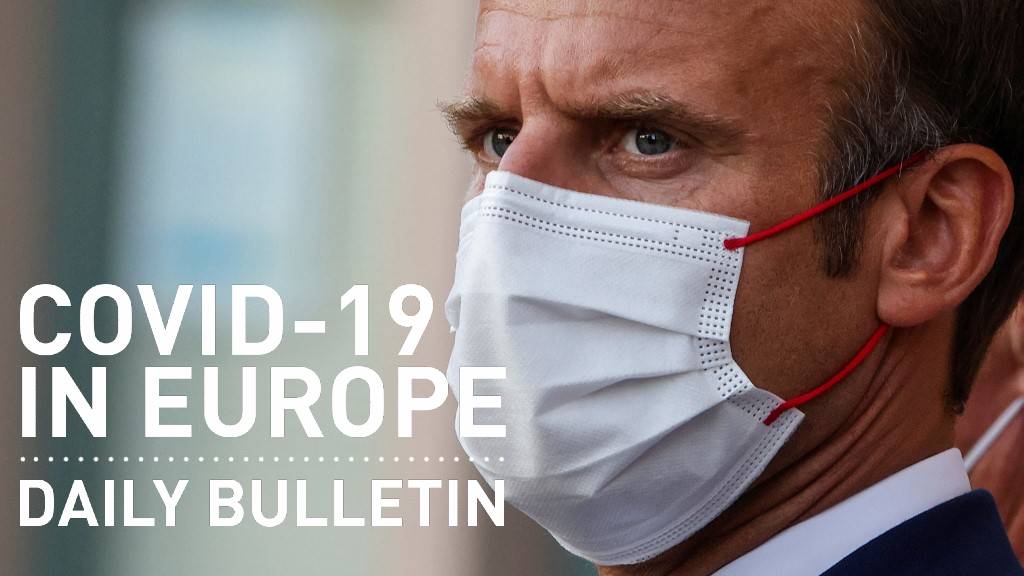
France's hospitalizations reached their highest levels in two months, putting President Emmanuel Macron's government on alert. /Eric Gaillard/POOL/AFP
AROUND EUROPE
Ross Cullen in Paris
The French government is planning for a third vaccine dose for people aged over 65 from the start of September. It comes as the number of patients in intensive care passes 2,200. There were 1,000 people in urgent care at the start of July.
Health Secretary Olivier Veran said the peak of the fourth wave of infections "could be reached in the coming days." He added that "the impact of vaccination ... the impact of the health pass" and "our ability to test the public" now allows ministers to view the overall health situation with less concern than at the start of the summer before the mass holiday season got under way.
Hospitals in the southern Marseille-Nice region are severely stretched, however, with some patients having to be moved to medical facilities elsewhere in the country with more capacity at the moment, such as Strasbourg.
READ MORE
The Taliban is 'the people's choice'
The spoon revolutionizing meals in space
Ryan Thompson in Frankfurt
Germany will stop using seven-day incidence rates as its key severity metric to decide when to apply new COVID-19 restrictions.
Chancellor Angela Merkel announced the decision Monday, with the justification that the figure is less relevant as the number of people who are fully vaccinated continues to rise.
Instead, Germany's 16 states will have the power to decide when to introduce new measures based on the current state of hospitalizations. If beds become overburdened, they will be expected to rein in freedoms for those who are unvaccinated.
Incidence rates have previously been a key measure for the government in deciding whether restrictions could be imposed or lifted. Three thresholds of 35, 50 and 100 per 100,000 people triggered the opening and closing of restaurants, shops, schools, and other parts of public life.
Nawied Jabarkhyl in London
The UK has agreed to buy 35 million more doses of the Pfizer-BioNTech vaccine. The country is preparing to roll out booster jabs for vulnerable people next month. But the World Health Organization has criticized the move, saying vaccinations should be shared with poorer nations first.
And almost 5,000 new infections are thought to be linked to a music and surf festival in the southwest of England. Officials are looking into the Boardmasters event in Cornwall as thousands tested positive after attending it. Cornwall is one of the UK's most popular tourist destinations, driving fears an outbreak could spread.
Penelope Liersch in Budapest
The mayor of Slovakia's capital Bratislava has announced at least 74 percent of over-50s have received at least one dose of the vaccine. If the city can get its rate over 75 percent, all districts will move down the automatic virus alert system, meaning the strictest measures will not be applied in Bratislava if cases rise.
Slovakia will donate AstraZeneca vaccines to Ukraine and Montenegro, according to the country's foreign minister Ivan Korcok. Ukraine will receive 60,000 doses and Montenegro 10,000.
Authorities in Hungary have announced 200,000 people have received a third dose of a vaccine since the program began this month. First-dose vaccinations are at 5.7 million and 5.5 million people have had a second dose.
FROM OUR GLOBAL COLLEAGUES
CGTN Europe: Is this inhaled vaccine the answer to our Covid-19 woes?
CGTN China: Cell: No evidence of novel coronavirus originating from a laboratory
CGTN America: Colombia begins lifting COVID-19 restrictions
CGTN Africa: China donates 300,000 COVID-19 vaccine doses to Ethiopia
Sign up here to get the COVID-19 Europe bulletin sent directly to your inbox.
CGTN Europe has been providing in-depth coverage of the novel coronavirus story as it has unfolded.
