- Home
- China
- World
- Asia-Pacific
- Americas
- Europe
- Middle-East and Africa
- Politics
- Business
- Opinions
- Tech & Sci
- Culture
- Sports
- Travel
- Nature
- Picture
- Video
- Live
- TV
- Specials
- Learn Chinese

 Europe;
Share







Copied
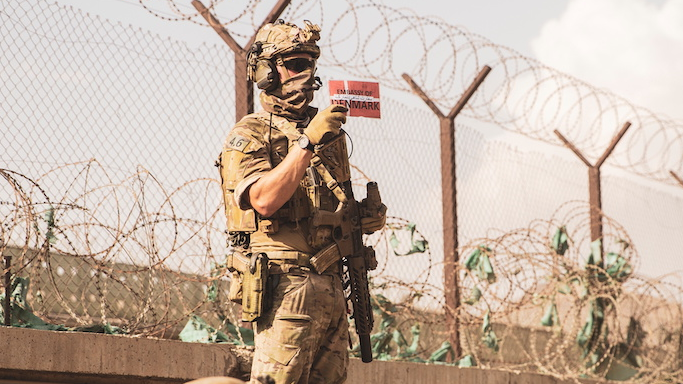
A Danish soldier at Kabul airport holds a flag to help refugees with links to the country organize evacuation. /U.S. Marine Corps/Staff Sgt. Victor Mancilla/Handout
Events have been moving fast in Afghanistan since the Taliban took control in Kabul. Here's a round-up of the latest events as Western governments scramble to respond.
At least one person was killed on Monday morning in a gunfight at Kabul airport. The German military published a statement saying "unknown attackers" were responsible.
Reports suggested Taliban militants were corralling Afghans who want to leave into lines, to ease congestion and risk of crushing at the airport gates.
But as the deadline for foreign forces to leave the country (August 31) approaches, both sides are lobbying U.S. President Joe Biden.
UK Prime Minister Boris Johnson is expected to challenge Biden at Tuesday's (virtual) G7 meeting, as MPs have pressured his government to extend its support to Afghanistan after the end of August.
Germany's Foreign Minister Heiko Maas added his voice to calls for an extension to the August 31 deadline, and said conversations with that aim had already begun.
"We are talking with the United States, Turkey and other partners with the aim of facilitating a civil operation of Kabul airport to enable the evacuation of people [beyond August 31] . We will also have to continue to talk with the Taliban about this issue, and that's what we are doing," Maas said.
But a Taliban spokesperson said any extension to the agreed deadline would be "a clear violation" of the agreement signed by Biden's predecessor Donald Trump and the Taliban in 2020.
"If the U.S. or UK were to seek additional time to continue evacuations, the answer is no. Or there would be consequences," Taliban spokesman Suhail Shaheen said.
In a briefing in Washington D.C. a State Department official said the U.S. would remain committed to "at-risk Afghans" after the deadline, but according to Reuters news agency, it did not go further in explaining how the U.S. could help after its complete withdrawal from Afghanistan.
On the other side of the Atlantic, Dmitry Peskov gave a statement after Russia's President Vladimir Putin spoke with leaders of Russia's allies. Peskov said Putin "expressed particular concern that ISIS holds a strong position in Afghanistan, and this... poses a threat."
Peskov added Putin, along with the leader of Tajikistan which borders Afghanistan and Russia, are also wary of the "narcotraffic" coming from Afghanistan. The country has historically been where much of the world's opium poppies are grown, and turned into heroin for export.
Meanwhile, 14 years after he left office, former UK Prime Minister Tony Blair wrote a broad attack on the decision to withdraw from the country and urged world leaders to support Afghans and set clear warnings "so the Taliban understand their actions will have consequences."
"We need to draw up a list of incentives, sanctions and actions we can take, including to protect the civilian population," he wrote.
"This is urgent," Blair added.
Tuesday's video conference G7 will discuss possible sanctions on the Taliban.
Johnson said it was the G7's role to help those who want to escape, but also to "prevent a humanitarian crisis and support the Afghan people." UK Foreign Minister Dominic Raab raised the idea of sanctions on the Taliban last week.
Biden said he would support new sanctions, but said it depends on Taliban "conduct."
But not everyone agreed. Rory Stewart, former UK International Development Minister who previously worked in the region, said sanctions would not hit the right people.
"Please no. Sanctions – unless very carefully designed – will inflict pain on innocent Afghan communities and have almost no impact on the Taliban. If we impose general sanctions and cut aid inside Afghanistan now, we will deepen a humanitarian catastrophe, [and] create more refugees," he said.
Meanwhile, the Taliban have named Haji Mohammad Idris as acting governor of the Afghanistan central bank in an attempt to improve the failing economic situation. Banks are still closed said they would need central banking help before reopening.
Although evacuations from Kabul have been carried out by NATO members, it is U.S. troops that dominate the airport and its security perimeter.
The UK, Germany and others have troops "on the ground" to assist with the airlift, but European governments said they will not be able to support further extractions after the U.S. decides to remove its forces.
UK Defense Minister Ben Wallace said time pressure was increasing and the U.S. departure would be a hard deadline for UK troops in Kabul.
"We are down to hours, not weeks and we have to make sure we exploit every minute to get people out," he told UK reporters.
France's Foreign Minister Jean-Yves Le Drian, who is in the UAE to oversee France's operation in Kabul, seemed to agree with the U.S. and suggested NATO forces should leave Afghanistan soon.
"We need time to accomplish this task, measured in days and weeks not months," Le Drian told the Journal du Dimanche.
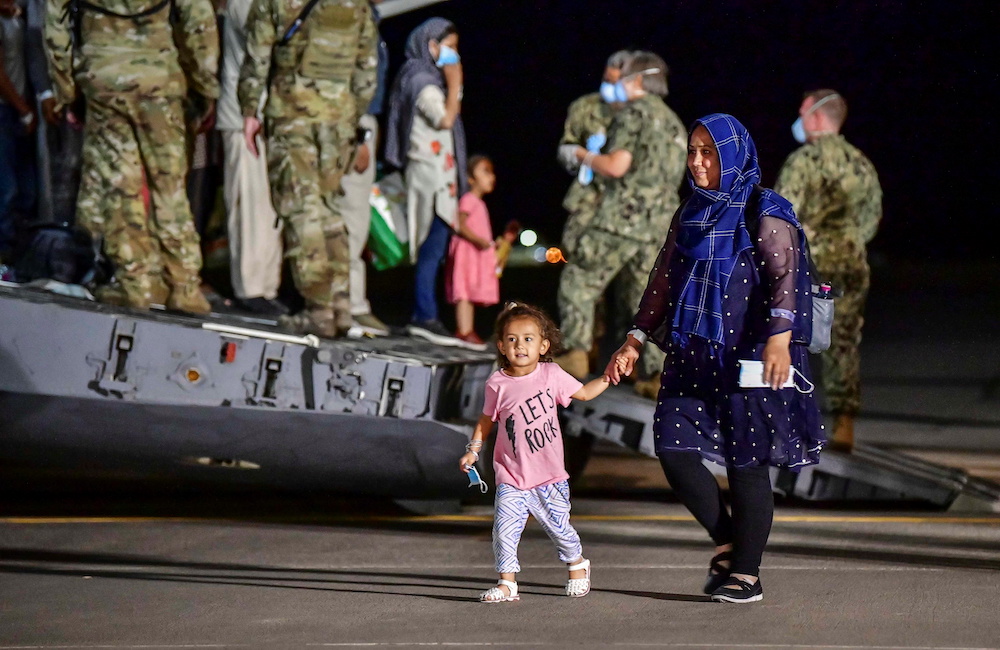
A mother and child arrive at a U.S. military base in Italy after evacuation. /U.S. Navy/Mass Communication Specialist 1st Class Daniel Young/Handout
Another UK minister, James Heappey who is responsible for the armed forces, said the effort to evacuate could not move faster because troops are checking Afghans against extremist watch lists.
"There are people right now in Kabul trying to get on to British flights who we have identified in our checks as being on the UK no-fly list. So the checks that are being done are entirely necessary because there are people trying to take advantage of this process to get into the UK to cause us harm."
While several European nations continue to attempt to evacuate their nationals and Afghans who worked with NATO during the 20-year conflict, others are focusing on the impact at home.
Greece has built a 40km-long fence along its border with Turkey, after Turkey's President Recep Tayyip Erdogan said "a new wave of migration is inevitable."
Greece's Citizens' Protection Minister Michalis Chrisochoidis said the country would not be "passive."
"Our borders will remain inviolable," he added.
And Austria's Chancellor Sebastian Kurz said the country "will not take any refugees from Afghanistan." He cited what he called "problems with integration" when announcing the decision.
