- Home
- China
- World
- Europe
- Politics
- Business
- Opinions
- Tech & Sci
- Culture
- Sports
- Travel
- Nature
- Picture
- Video
- Live
- TV
- Specials


Share







Copied
"Next year we will continue to be forced to suspend the debt rule and spend considerable funds to protect the health of citizens and stabilize the economy."
These were the words of German Finance Minister Olaf Scholz in an interview with the Funke media group on Friday, as he let the country know that its cherished policy of keeping a balanced budget is still to be put on hold to support the German economy navigating through the COVID-19 crisis.
Scholz, who plans to borrow $258bn this year to fund the national recovery, said he is expecting the economy to return to pre-pandemic levels "by the end of next year or the beginning of 2022".
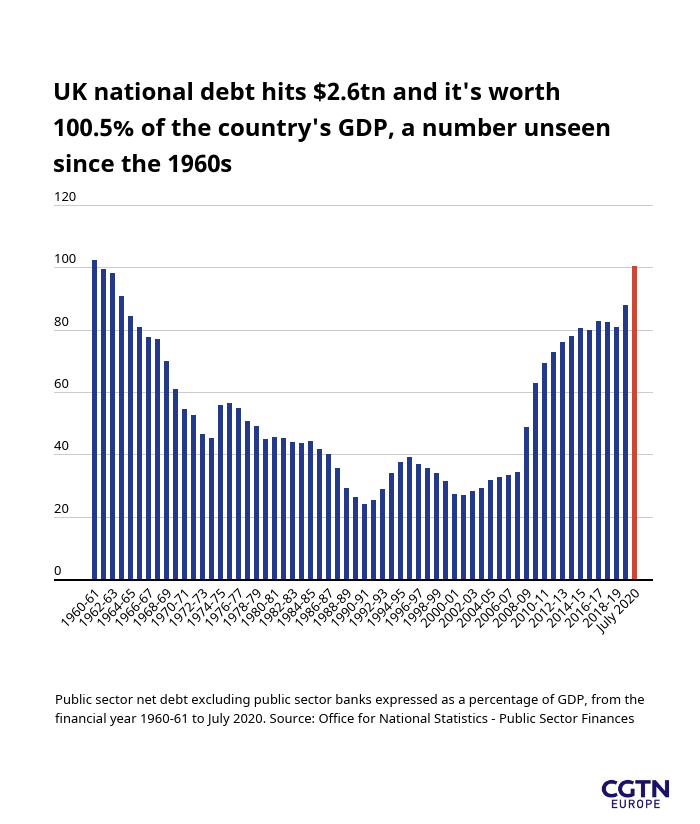
Also experiencing a surge in spending is the UK, whose national debt has reached a historic height of 2.6 trillion dollars. Since April, the country has borrowed almost $200bn to support its furlough scheme and its suffering industries. We look into the growth of Britain's national debt from the financial year 1960-61 until today.
Looking at those who are thriving amid the pandemic, today's interview gives us more insight on how Apple has hit the $2tn market capitalization in just two years after it became the world's first trillion-dollar company.
Finally, our video looks at the EU's plans to prioritize hydrogen in its goal to reach climate neutrality by 2050, and what kind of controversies the energy source is fueling.
Enjoy reading,
Giulia Carbonaro
Digital correspondent
P.S. Did you know we send this briefing by email, too? Sign up here
Britain's national debt has risen to $2.6tn (£2tn) due to spending to support the economy during the pandemic. The national debt now accounts for 100.5 percent of the country's GDP, the first time debt rises above 100 percent since the 1960-61.
Germany will have to take on more debt in 2021 to mitigate the impact of the pandemic on the national economy, as announced by the country's finance minister Olaf Scholz. He plans to borrow around $258bn (€218bn) already this year.
Airbnb bans house parties and limits guest numbers in its renewed efforts to fight off fear of the virus. The ban covers all the company's properties worldwide, which won't allow more than 16 guests at one time.
Beauty chain Estée Lauder plans to cut up to 2,000 jobs globally after reporting a huge dive in profits after the temporary closure of its shops during the pandemic.
Lego has launched a Braille version of its iconic plastic bricks to encourage blind and visually impaired children to find new ways of learning to read and write. The new bricks will be first sold in 7 countries only before being extended to other 13 countries early next year.
Burberry has launched a $120 (£90) face mask – becoming the first major luxury brand to launch a high-end face covering. The UK fashion brand said 20 percent of the revenue will go to help health care professionals and others impacted by COVID-19.
Deutsche Bahn – Europe's largest rail operator – is under fire for refusing to share real-time data with its passenger on how busy its trains are to support social distancing.
The European Central Bank warns that a rise in unemployment is to be expected this autumn in the eurozone, despite countries slowly starting their economic recovery as the labor market is lagging behind.
Alibaba reported a year on year increase of 34 percent in revenues, after its sales were expected to decrease as a result of growing competition and the U.S. shifting policies towards Chinese companies.
The EU's Green Deal puts hydrogen as a priority area to achieve a "climate neutral" Europe by 2050. Hydrogen is an infinite energy source and it's not only highly efficient, but also safer than nuclear power or natural gas. Despite its benefits, hydrogen energy is fueling a lot of controversy. Why?
Apple's market value has hit $2tn only two years after it hit the $1tn milestone, making it the world's largest listed company. CGTN Europe talked to Santosh Rao, Head of Research at U.S.-based research-driven merchant bank Manhattan Venture Partners, about this incredible achievement.
What's the secret of their success?
This is nothing short of spectacular. It's an amazing growth. But I think there is a combination of reasons why the stock has really taken off. It's mainly multiple expansion, because their revenue and EPS growth has been pretty muted and it hasn't been very spectacular. But I think multiple expansion, then the whole COVID-19 crisis and the stay-at-home phenomenon has pushed the whole revenues forward. And then overall, I think there is a good tailwind behind it, because it's been put into the basket of safe haven stocks. So all these factors have really played into this whole tailwind behind the stock.
Let's talk about products and services. Which new Apple products and services have particularly attracted a growing user base, new customers?
The whole menu of Apple products, they're all very popular and they're designed for the market that we have right now. So the kids love it, now, even the adults love it. So I think it's overall that's all added in here and that's helping. But overall, the services' part of the business has really anchored the company a little bit, because the top line is pretty muted. If you notice, the last quarter, you've got sales pulled forward, but other than that it was a pretty normal quarter. But it's the services anchor and the expectation of the 5G supercycle that's really out there, that's really powering this thing ahead.
Is there room to grow any further?
Maybe another 400 million or 500 million, I would say. But beyond that, about 2.4 billion, you really have to stretch your expectations of margin expansion and growth expansions.
In our graphics today we looked at the UK's national debt as a percentage of the country's GDP from 1960 until July 2020.