- Home
- China
- World
- Europe
- Politics
- Business
- Opinions
- Tech & Sci
- Culture
- Sports
- Travel
- Nature
- Picture
- Video
- Live
- TV
- Specials


Share







Copied
- In England, face masks will be compulsory in all shops from 24 July, with fines of $125 for those not complying. There are exemptions for children aged under 11 and those with disabilities. Face masks are also recommended in other indoor crowded spaces.
- France has approved pay rises worth $9 billion for health workers. The deal was signed with trade unions on Monday after weeks of negotiations. Wages will rise by just over $207.
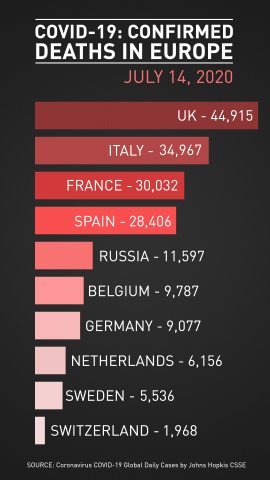
- The UK could suffer about 120,000 new coronavirus deaths in a second wave of infections this winter, scientists warn. There have been 44,830 official deaths in the UK.
- France is holding scaled-down Bastille Day celebrations, with 2,000 troops gathering for a ceremony at the Place de la Concorde to pay tribute to health workers. Spectators will watch the event from platforms and will include the caregivers of those who have died during the pandemic and the health ministers of four countries that took in patients (Austria, Germany, Luxembourg and Switzerland).
- Demand for credit among eurozone firms hit 17-year highs in the coronavirus-stricken second quarter, European Central Bank (ECB) data showed on Tuesday. Demand for consumer credit sank to all-time lows.
- Banksy has produced new tube lockdown art. The work is in a Circle Line tube carriage, and is called If You Don't Mask, You Don't Get. It features several rats in pandemic-inspired poses, wearing face masks.
- Virgin Atlantic has secured a rescue package worth $1.5 billion with its shareholders and investors, in an attempt to shore up its finance beyond the coronavirus pandemic.
- Belgium has reported zero deaths related to COVID-19 in the past 24 hours, for the first time since the pandemic started in March. The country's death toll was 9,787 on Tuesday, according to Johns Hopkins University.
- Tighter lockdown restrictions could be introduced in Blackburn, UK, following a spike in coronavirus cases.
- Dutch Prime Minister Mark Rutte said on Tuesday he was "not hopeful" of a deal on an EU coronavirus fund this week, despite opening the door to compromise on a key hurdle.
- French President Emmanuel Macron said on Tuesday that face masks could soon be required in public indoor spaces to curtail the coronavirus outbreak, acknowledging that it is once again on the rise.
- Globally, more than 13 million people have now been infected with the virus, with a million cases being added in the past week. Countries around the world have announced renewed lockdowns as cases once again rise.
Stefan de Vries in Paris
France's Bastille Day will be understandably different this year.
Following coronavirus measures, the traditional parade on the Champs Elysées has been cancelled for the first time since the World War II. Instead, there will be a military ceremony on the Place de la Concorde in the heart of Paris, attended by the French Government and 2,000 guests.
There has been a slight increase in the number of infections in France.
In certain regions, such as on the Atlantic Coast and around the Côte d'Azur in the south, the reproduction number (the average amount of people infected by one case) is now above one again, indicating a rise in the number of COVID-19 cases.
The situation in the overseas territories of French Guiana, in South America and Mayotte, in the Indian Ocean, is worrying the authorities. Guiana has not hit the peak of the outbreak, while the number of infections in Mayotte is only slightly decreasing.
Flights from and to these regions and mainland France are banned. The government is now considering making protective face masks obligatory in indoor public spaces.

France holds a reduced version of its traditional Bastille Day celebrations due to the coronavirus pandemic. /Ludovic Marin /AFP
Holly Hudson in Frankfurt
Schools do not play a major role in spreading the coronavirus, according to the results of a German study.
The study, the largest conducted on German schools where there have been coronavirus outbreaks, found fewer than one percent of school children and teachers had traces of the virus.
Only 12 of the 2,000 schoolchildren and teachers tested in the German state of Saxony by scientists from the University Hospital in Dresden showed antibodies to COVID-19.
Reinhard Berner, a professor of paediatrics at the hospital, said the results gave no evidence that school children played a role in spreading the virus particularly quickly and that "children may even act as a brake on infection."
Saxony's education minister, Christian Piwarz, said the study showed schools in the state could reopen as normal after the summer holiday at the end of August, but with some conditions, such as mask-wearing and social distancing where possible.
Germany began reopening schools in May, though debate continues as to the role children may play in spreading the virus to vulnerable adults at home as well as to older teachers and school staff.
Nicole Johnston in London
The British Government has announced it will make wearing a mask compulsory in shops in England from 24 July, or the public will face a $125 fine.
But the country still lags many others in using face coverings in enclosed areas. A recent survey found that in Singapore and Japan up to 90 percent of people wear masks. In France and the U.S. around three-quarters of the population wear masks. In the UK the figure is 36 percent.
British Prime Minister Boris Johnson has now been seen wearing a mask in public enclosed areas.
"I do think that in shops it is very important to wear a face covering, if you're going to be in a confined space and you want to protect other people and to receive protection in turn," Johnson said.
It's already compulsory to wear a mask on public transport in England. However, the London Metropolitan Police force says it will be "impossible" to enforce face coverings in shops.
Some high street retailers are also asking why the government didn't introduce masks earlier in the pandemic. The government continues to insist it was "led by the science."

UK Prime Minister Boris Johnson wears a face mask, which will be mandatory in England's shops and supermarkets from 24 July. /Ben Stansall/AFP
FROM OUR GLOBAL COLLEAGUES
CGTN Europe podcast: Notes on a pandemic: Science rules
CGTN China: COVID-19 Frontline: Experts' experiences on COVID-19 control
CGTN America: Infected deportees sent back to Guatemala cause a rise in COVID-19 cases
CGTN Africa: Zimbabwe’s COVID-19 cases pass 1,000 mark
Sign up here to get the COVID-19 Europe bulletin sent directly to your inbox
CGTN Europe has been providing in-depth coverage of the novel coronavirus story as it has unfolded. Here you can read the essential information about the crisis.