- Home
- China
- World
- Europe
- Politics
- Business
- Opinions
- Tech & Sci
- Culture
- Sports
- Travel
- Nature
- Picture
- Video
- Live
- TV
- Specials

 Europe;United Kingdom
Share







Copied
The UK's National Health Service, or NHS, is celebrating its 72nd birthday in what its chief executive, Simon Stevens, said "has been the most challenging year" in its history.
The public health system has been at the forefront of Britain's fight against COVID-19.
According to NHS figures, it has cared for 100,000 patients so far with the virus. It has also had to set up makeshift hospitals across the UK to combat the disease.
At 16:00 GMT on Sunday, people across the UK applauded in unison to show their appreciation for the frontline staff who've been fighting COVID-19.
"The beautiful thing about this pandemic, if one can phrase it in that way, has been a realignment of heroes. And our key workers, we are recognizing now, are the frontline of not only our health but also our sanity," said Kwame Kwei-Armah, spokesman for the Together Coalition.
The coalition is working with the NHS to encourage people across the UK to take part in celebrations.
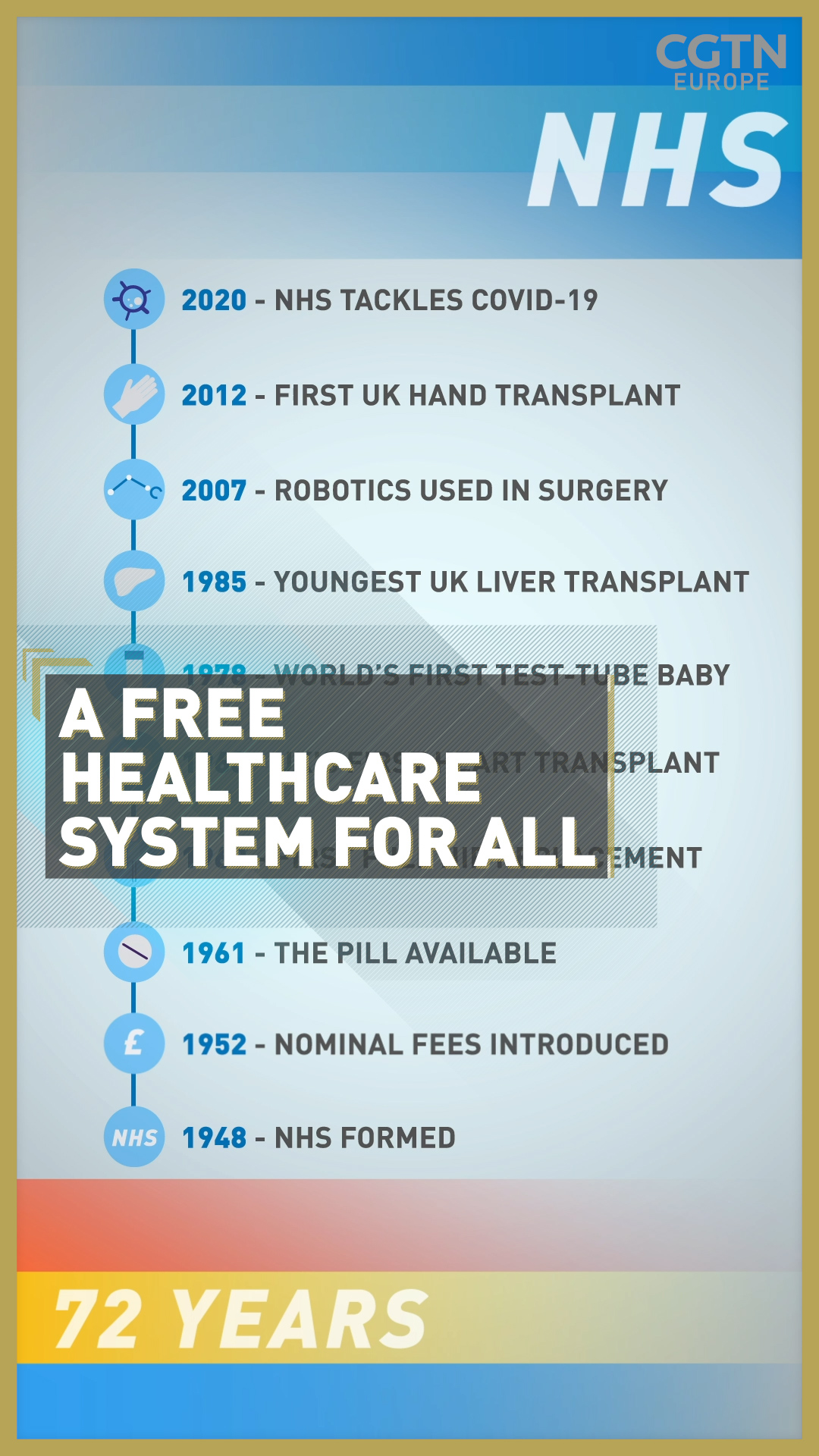
Although parts of the UK are relaxing lockdown measures this week, a few months ago, it was a very different picture for the NHS, with hospitals inundated with COVID-19 patients.
The challenging experience has led to calls for more investment in the health service to ensure it is better equipped to deal with similar challenges in the future.
Prime Minister Boris Johnson was taking part in the celebrations and has paid tribute to the NHS. It is a day that will have particular significance for him after he was hospitalized with coronavirus in April. He said the NHS saved his life.
As Britain looks ahead to a post-COVID-19 world, the government says it wants to ramp up investment in the NHS, despite previous Conservative governments being accused of not giving enough funding to the service in recent years.
"The prime minister announced another one-and-a-half billion pounds for the NHS. That will be to expand our A&Es (accident and emergency departments) for this winter because with social distancing, many A&Es across the country are going to need to be bigger," said Matt Hancock, the UK's Health Secretary.
"It's also for maintenance, which is much needed, and to get on with capital projects," he added.
More than seven decades after it was first launched, the UK's NHS is arguably more important than ever.
The coronavirus pandemic has highlighted the plight of the service as well as its strength. With 1.9 million people working across the NHS, it is a key pillar of the UK's economy and as a result of the coronavirus, one that has firmly cemented its place in British hearts and minds.