- Home
- China
- World
- Europe
- Politics
- Business
- Opinions
- Tech & Sci
- Culture
- Sports
- Travel
- Nature
- Picture
- Video
- Live
- TV
- Specials

 Europe;
Share







Copied
"You could be on the golf course in the unlikely event the Home Office calls you – all they will have is a mobile number."
That's the view of Michael O'Leary, CEO of low-cost airline Ryanair, who spoke to Sky News to criticize the British government's 14-day quarantine plan for arrivals at airports. He was speaking after Ryanair and fellow low-cost carrier easyJet signed the letter sent by British Airways' parent firm to start a legal challenge against the measures.
Meanwhile, travelers who are found to flout the rules can be fined from today.
As the air travel industry wrestles with COVID-19 controls, the oil industry is already reacting. With oil prices remaining low, BP has announced 10,000 job losses (having already said it would pause redundancies during the pandemic, it said the layoffs would come at the end of the year).
And amid political, social, economic as well as biological turmoil, Facebook boss Mark Zuckerberg said the firm would review the policies which saw him roundly criticized for not reacting to a violent message from U.S. President Donald Trump to Black Lives Matter protesters.
Finally, in today's video we look at how Milan is planning to return with a greener shade when its streets reopen fully after the pandemic.
Happy reading,
Patrick Atack
Digital business correspondent
P.S. Did you know we send this briefing by email, too? You can sign up to receive it here.
Germany's industrial output dropped by close to 18 percent in April, according to new data from the country's statistical office, which charts the economy's changes since March. The numbers for the automotive industry were especially stark, with production down 75 percent.
Facebook CEO Mark Zuckerberg said the company would "review" its policies following staff criticism that it did not label U.S. President Donald Trump's message in a similar way to that of its rival, Twitter. Zuckerberg said the review would consider alternatives to what he called "binary leave-it-up or take-it-down decisions."
Oil major BP said it will cut 10,000 jobs – 15 percent of its global workforce – by the end of the year. CEO Bernard Looney told staff of the cuts in an email, adding that falling oil prices meant the company is losing significant sums: "I am talking millions of dollars, every day," he said.
China's exports in May declined 3.3 percent year-on-year, but beat market expectations. Analysts attributed the better-than-expected performance to a production catch-up following the COVID-19 pandemic and a continuation of strong exports of medical products.
The COVID-19 lockdown continues to have a serious effect on the luxury consumer sector, with UK-based fashion house Mulberry announcing a 25 percent cut to its staff of 1,500. There are spring shoots of recovery, though, as the brand has opened China and South Korea stores, and is trading online globally.
Two airlines based in the Arabian Gulf, Emirates and Etihad, have extended their salary cuts until September. The UAE last week lifted layover restrictions, raising hopes of a swift return to normal service. But staff were told their reduced wages, which were supposed to return to 100 percent at the end of June, will be extended to September – with some salaries cut further to 50 percent.
While salons and barbers have been closed across much of the U.S., health and beauty sales actually rose between the start of March and the middle of May, compared with the same period last year. The sector brought in $32.2 billion, an increase of $3.74 billion – with e-commerce leading the increase, rising 31 percent.
Travel firms in the Pacific island nation Fiji have been lobbying for the country's inclusion in the Australia-New Zealand "travel bubble" to save the island and its neighbors' heavily tourism-dependent economies. The Trans-Tasman "bubble" is expected to open between Australia and New Zealand in September, following the eradication of COVID-19 from the nations.
Didi Chuxing, which dominates China's ride-hailing market, said demand has returned to levels last seen in June 2019. According to CEO Cheng Wei, the company's peak orders are hitting 30 million per day, while Didi Bike's daily orders are reaching 10 million.
Mall construction in the Middle East and Gulf has paused, as the pandemic hits customer numbers and oil prices remain low. Majid Al Futtaim has delayed the launch of the Mall of Oman, while Dubai's Emaar Malls has stopped construction on two new malls in the region.
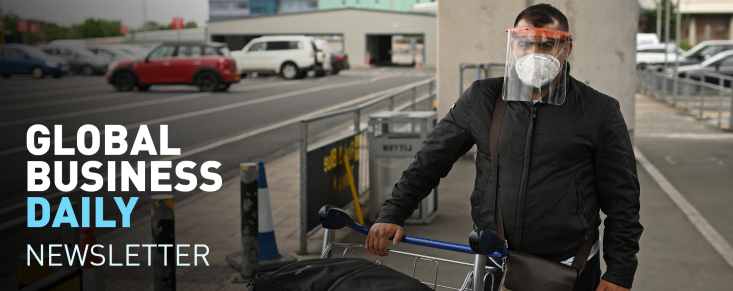
London Heathrow Airport's boss John Holland-Kaye told UK media the country would face losing "hundreds of thousands if not millions of jobs" if the government's 14-day quarantine plans for arrivals go ahead as planned. The policy begins today.
Meanwhile, British Airways' parent company, IAG, has launched a legal challenge to the policy, which has been co-signed by easyJet and Ryanair. The airlines hope to force a judicial review of the government's decision, which was described as a "political stunt" by Ryanair boss Michael O'Leary.
South African asset management firm Ninety One has started a $600 million fund to target investments in companies struggling with the effects of the pandemic. The SA Recovery Fund is set up in partnership with Ethos Private Equity, Ninety One said.
Chinese companies invested 58 percent less in the Australian economy in 2019, compared with the previous year, according to a joint report by KPMG and the University of Sydney. At $2.3 billion, it is the lowest level of Sino-Australian investment in 10 years.
Video:
The Italian city of Milan is launching a transformational project called "Strade Aperte," which translates as "Open Roads."
The city will soon benefit from a significant increase in the number of cycle routes and pedestrian roads: a transformation inspired by the impact of COVID-19. Amid the pandemic, when traffic was extremely limited, officials observed positive environmental side-effects, which prompted the decision to cut car use and, with it, pollution.

In an interview with CGTN Europe, the vice president of Huawei UK, Jeremy Thompson, said the Chinese firm had been working in the UK for almost 20 years.
"We have helped build the 3G and 4G networks, some people question our role in 5G, so we wanted to state our commitment, that we're committed to the UK and committed to invest and build the networks here in the UK," Thompson said.
In January, Huawei was allowed to play a limited role in the UK's 5G networks, following a major review by the government.
At the time, British intelligence agencies said they found no evidence that the company was used for spying by authorities in Beijing.
But, it was labeled a "high-risk" vendor and only allowed a maximum market-share of 35 percent in the UK's "non-core" networks – which include fewer sensitive aspects of 5G technology, such as masts and antennae.
"The government has restated the decision stands and we're focused on implementing that decision," said Thompson.
In recent months, some British lawmakers, mainly from Boris Johnson's Conservative Party have called for Huawei's role to be scaled back.
There is also pressure from the other side of the Atlantic. U.S. President Donald Trump has called on the UK to ban Huawei from its 5G networks, something the U.S., Australia and New Zealand have already done.
"Britain can join the United States and other powerful nations to work together on a 5G solution that doesn't empower Chinese intelligence," said Tom Cotton, a Republican U.S. senator.
Those calling for a ban on Huawei say that working with the company would lead to security concerns, because of its links to the Chinese government. That's a concern with 5G, given that it's a nascent technology and highly dependent on data.
Huawei's Thompson rejected those claims: "About 50 percent of our revenues come outside China, and so we abide by the laws and regulations of 170 countries worldwide. We've stated that many, many times. Our business would collapse overnight if we were to even contemplate that, which we don't. We've never been asked to hand over data by the Chinese government."
By Nawied Jabarkhyl