- Home
- China
- World
- Europe
- Politics
- Business
- Opinions
- Tech & Sci
- Culture
- Sports
- Travel
- Nature
- Picture
- Video
- Live
- TV
- Specials

 Europe;
Share







Copied
"Our best bet for this year is to focus on domestic tourism, but of course that will depend on how Spanish families can recover after the crisis."
That's Jose Miralles, president of Valencia's hoteliers association, who spoke to CGTN Europe's Madrid correspondent Rahul Pathak about the effect of COVID-19 on the mediterranean nation's large tourist sector.
You can watch his full report from the eastern Spanish coast below – as new figures show Spain's industrial output fell 12 percent in March, compared with the same period in 2019.
Meanwhile in Europe, the Republic of Ireland has reported a historic jump in unemployment. Across the working-age population, 28 percent are without a job – but the situation is even worse for young people, as 52 percent of 15-24-year-olds are jobless.
Canada is suffering a similarly historic rate of unemployment, at 13 percent – the highest in the nation for nearly 40 years.
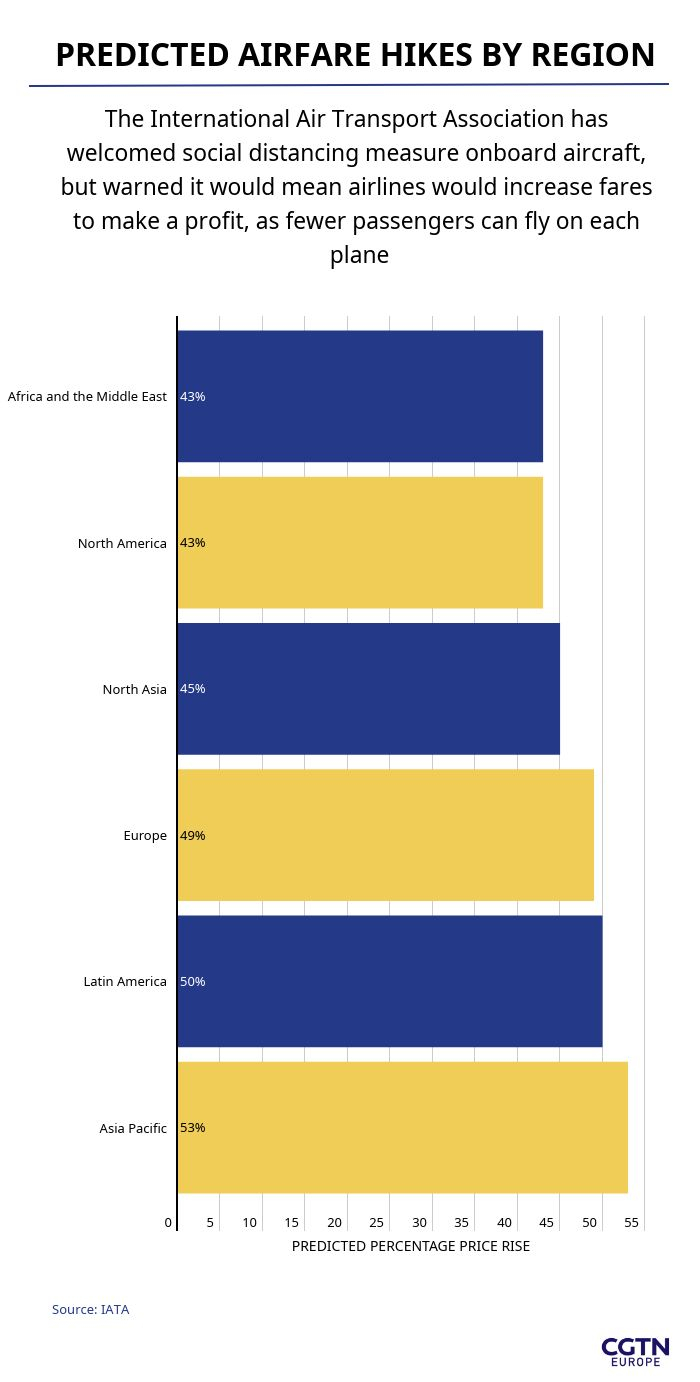
But looking ahead to lockdown lifting and beyond the pandemic, the International Air Travel Association has put together regional figures for how it expects air fares to change in the medium term. You can see the predicted increases in today's graph.
Happy reading,
Patrick Atack
Digital business correspondent
P.S. Did you know we send this briefing by email, too? You can sign up to receive it here.

Spain's industrial output fell by more than 12 percent in March, according to new year-on-year figures from the country's National Statistics Institute. That's compared with a 1.5 percent drop in February.
Consumer confidence in the UK rose slightly in April, but remains close to its lowest historic levels, according to polling firm GfK. The Savings Index, on the other hand, rose by nine points, indicating a mood of caution.
Irish unemployment has risen to its highest recorded level, at more than 28 percent, as figures from the Central Statistics Office show 52 percent of people aged between 15 and 24 are out of work, education or training. The Republic's jobless rate was a meagre 4.8 percent at the start of the pandemic.
Ride-hailing firm Uber has recorded a first-quarter loss of $2.9 billion, despite an apparent recovery in ride numbers, according to CEO Dara Khosrowshahi. The company's revenues have risen, however, thanks to its food delivery arm.
Amazon said it will challenge the restrictions placed on it by a French court, and will take it to the country's highest legal body. In the meantime, though, its warehouses will remain closed until at least 13 May.
Japanese electronics producer Sony said it will begin making face masks for Japan's hospital workers. The firm has a medical tech arm and said it will repurpose eye shields made for surgeons.
Sharp, the electronics firm that makes parts for Apple's iPhone screens and cameras, has cut its 2020 profit forecast by 48 percent. Net profit is now predicted to be a full 80 percent lower than earlier forecasts, after production, distribution and supply chains were hit by COVID-19.
Facebook said it would let all staff who are able to work from home do so until the end of 2020, and it expects all physical offices to remain closed until at least 6 July.
European Central Bank president Christine Lagarde said on Friday the bank expects eurozone governments to have to borrow an additional $1.6 trillion to keep economies afloat as GDP across the bloc is expected to drop by an average of eight percent.
Canada has reported two million jobs lost since the COVID-19 outbreak, as unemployment jumped by at least five percent, to 13 percent, which is the biggest leap since 1982.

John Grant is an aviation consultant based in London. He spoke to CGTN Europe about the job losses the sector is predicted to face – and how the industry may look once COVID-19 has passed.
How many jobs are at stake within the sector?
Well, the estimates from the International Air Transport Association are for around 620,000 jobs in the United Kingdom and similar numbers across Europe. And that includes both direct and secondary and indirect employment. So not just airlines, but refueling companies, catering companies, etc... and then, you know, if you manifest that across the whole of the globe. It begins to tell you how big aviation is and how important it is to the whole global economy. So it is a worst-case scenario, but we need to recognize the magnitude of the challenge we're now facing.
This is so big. It's almost too difficult to take on the number. So let's just drill down into one case study. One airline, Air France-KLM, scrapped its full-year outlook, predicting significant losses to come… I wonder what kind of measures will that company have to take to simply stay in business?
Well, they're talking about retiring up to 20 percent of their fleet that they currently have at this moment. And, clearly, they've taken advantage of national furlough-type schemes. But more importantly than that, it's about the management completely being scaled back for three months and then the very slow and gradual recovery. We fell off a cliff as an industry on the 23 March, when millions and millions of seat [bookings] were wiped out and we're not going to see them come back quickly. So the challenge for the airlines is about the really, really careful management of this. And that includes things like going to suppliers to renegotiate in payment terms, particularly on aircraft, canceling aircraft orders. Everything is up for renegotiation as far as these airlines are concerned, including working agreements.
And I wonder if it's the little ones, the little nimble airlines that might survive here? I mean, is this the time of the survival of the smaller airlines?
I think we'll see the very, very large airlines around the globe, so the Air France-KLM, United and Nippon Airlines and some of the Chinese carriers coming out of this, relatively well placed for really building cash reserves. With smaller airlines, those that are in niche markets, so maybe operate on behalf of the government to remote airfields in various countries, and we see that in both Asia and in Europe and in the Americas, where they have their essential air service program – they will probably be OK as well.
It's those that are in the middle of the market, those that are not the size of Ryanair and easyJet that are going to struggle because they've got to rebuild cash reserves. Securing finance is going to be more costly for them than it has been in the past. Burdened new airline entrants could be an interesting dynamic in what we see happening, because if capacity does come back and demand comes back, starting a new airline with no debt –there are plenty of aircraft that will be available around the world to use and skills and pilots and all the things you need to start flying.