- Home
- China
- World
- Europe
- Politics
- Business
- Opinions
- Tech & Sci
- Culture
- Sports
- Travel
- Nature
- Picture
- Video
- Live
- TV
- Specials


Share







Copied
The European Union has reached one of its two key education targets.
More than 40 percent of EU citizens aged between 30 and 34 completed a higher level education in 2019 – obtaining a diploma, or getting an undergraduate or postgraduate degree.
The second target – ensuring less than 10 percent of 18 to 24-year-olds leave education or training early – is only 0.2 percentage points short of being met.
For both targets, women led the change: 45.6 percent of women completed a tertiary education in 2019 against 35.1 percent of men (a number technically below the target), with a staggering growth compared with the data collected in 2002, when only 23.7 percent of women had a higher education against 21.4 percent of men.
Similarly, the share of early leavers is higher among men: 11.9 percent of male students dropped out of education or training in 2019, against 8.4 percent of women. This widening gender gap in education to the disadvantage of men is a known issue in the EU.
While progress has been made in bridging it among early leavers (down 0.7 percentage points) the gap has grown by 3.8 percentage points in tertiary education, as the number of women with a higher education grew twice as much as that for men.
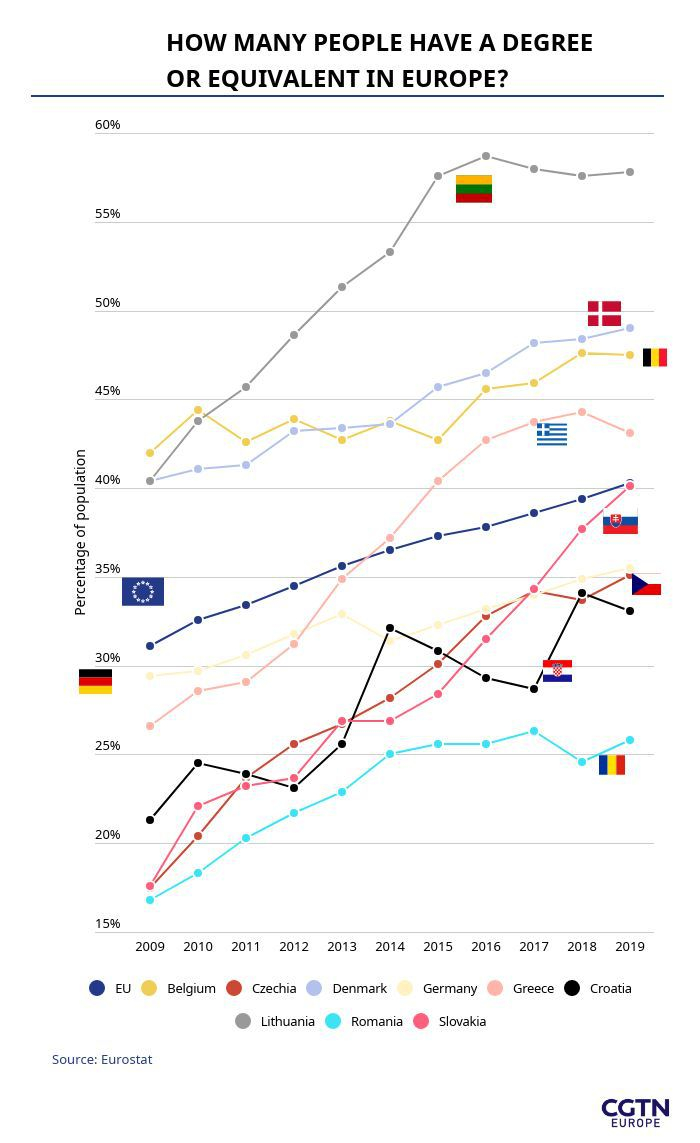
The EU has set education targets for all its member states overall, but the numbers vary significantly at the national level.
In tertiary education, 18 out of the 27 countries have already met or exceeded the target, while nine lagged.
Across the continent in 2019, half or more than half, of the population had completed tertiary education in: Cyprus (58.8 percent); Lithuania (57.8 percent); Luxembourg (56.2 percent); Ireland (55.4 percent); Sweden (52.5 percent); and the Netherlands (51.4 percent).
But in Italy, only 27.6 percent of citizens aged between 30 and 34 had a higher education in 2019 and in Romania, only 25.8 percent.
Romania has also one of the highest number of early leavers in Europe (15.3 percent), just after Spain (17.3) and Malta (16.7). While the lowest proportion of early leavers was recorded in some southern and eastern European countries such as Croatia, Slovenia, Lithuania, Greece and Poland – all with rates of less than 5 percent.
Other factors beside the gender gap have an influence: the rate of early leavers is higher among those who live in a different country from the one where they were born (20.7 percent).
The EU education targets for 2020 aim to create a workforce that's well prepared to enter the highly competitive European labor market and can support the economic growth the bloc needs to keep thriving – and now, to survive the economic downturn the pandemic will likely cause.